Calculation and Action — The World That Is Already There, and the World That Is Not Yet
The Image of 同人 is 君子以類族辨物. The noble one sorts things into kinds and tells one from another. Dividing calculation from action is this hexagram's work. The Judgment writes 利涉大川, it furthers to cross the great river.
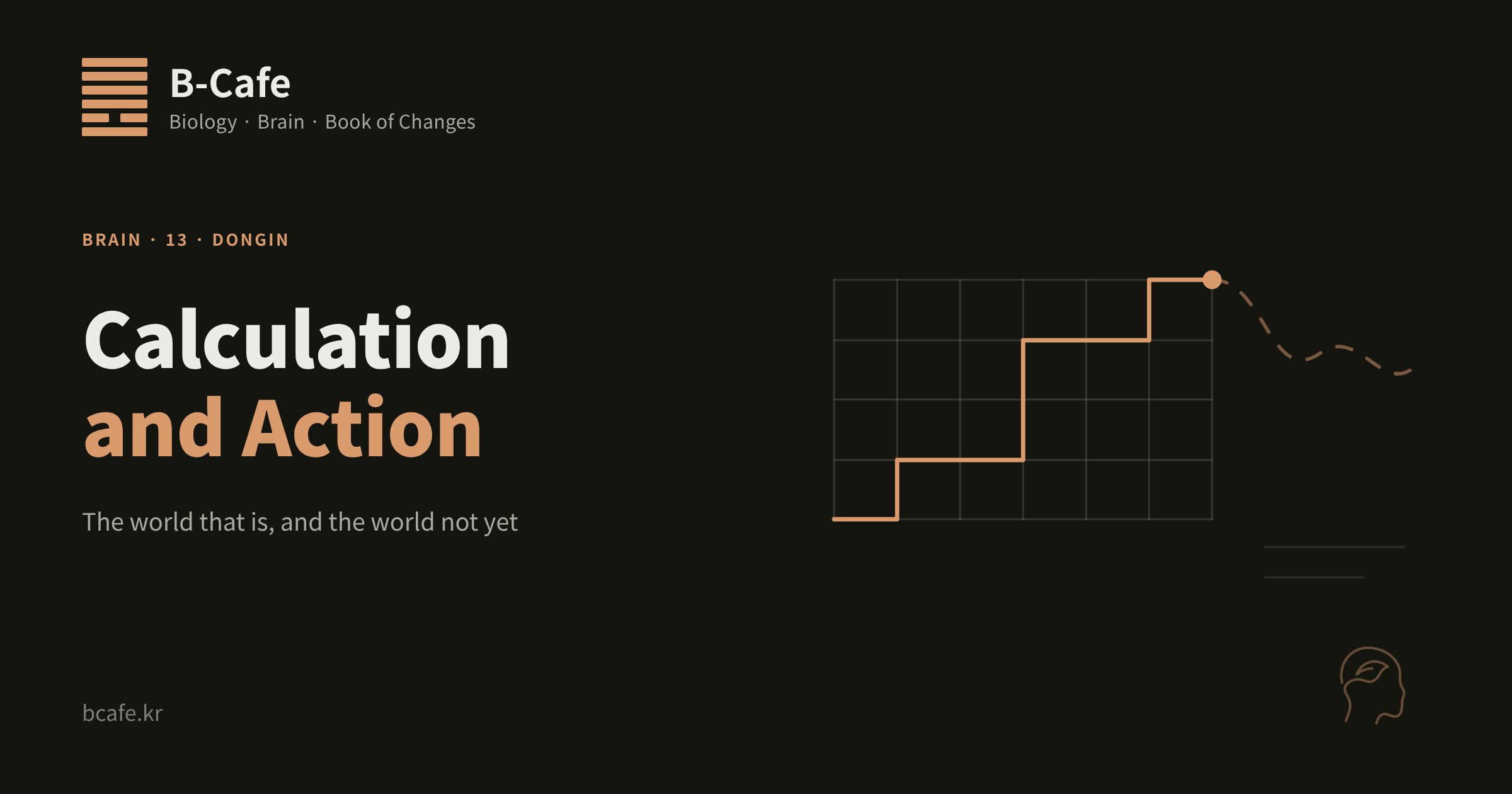
“O day and night, but this is wondrous strange.” — Horatio
“And therefore as a stranger give it welcome.” — Hamlet
Hamlet, Act 1, Scene 5
Meeting an exception in ordinary life, an unfamiliar uncertainty, a human being steps back by instinct.
He calls it an error, counts it as noise, and the phenomenon that will not be explained he pushes away in a hurry.
But the great souls who shook human civilization moved the other way entirely.
At the moment of finding the exception they did not turn away.
They took hold of it instead, took it in with the whole body, and made it the entrance to a new rule.
The unfamiliar was not an error.
It was an order not yet named.
That leap, which looks reckless, is the intelligence proper to a human being, the substance of imagination and intuition that the calculation of an AI finds hard to reach in the end.
Calculation, inside the world already there
To move already knowing the result is not action. It is not execution either.
It is no more than mechanical calculation — the answer already entered, the result waited for.
| Where it happens | |
|---|---|
| Calculation | inside the world that is already there |
| Action | goes into the world that is not yet there |
Real action begins where not an inch ahead can be predicted, in thick fog, the moment the first foot goes down.
Sometimes it begins in the instant the trigger is pulled.
An original plan is the same.
It always starts outside logic.
A logical, finely made plan is read by others too.
The plan that can be read dies first on the battlefield and is liquidated first in the market.
What Clausewitz actually wrote
Clausewitz, the Prussian strategist who thought harder than anyone about the limit of the Napoleonic war machine, had seen through to this.
Napoleon moved a whole army as one body. A genius of calculation.
Orders flowed from the top down, and the soldiers moved like parts of a huge machine.
It was precise. It was strong.
But war is the place where the exception is the daily thing.
The terms are fixed here exactly.
| The phrase in common use | What is the case |
|---|---|
| fog of war | Not a phrase of Clausewitz’s. A summary that set later. What Book I, Ch. 3 writes is that three quarters of the factors lie in a fog of greater or lesser uncertainty |
| friction (Friktion) | His own concept. On War, Book I, Ch. 7 |
| uncertainty | “War is the realm of uncertainty” — Book I, Ch. 3 |
Friction is the thing that is easy on paper dragging heavily in reality.
Not because the plan is wrong. The plan can be right and the body still not follow it that far.
And what he named as the core of military genius was not the capacity to calculate.
Coup d’œil — literally, one cast of the eye. The eye he means is the mental one more often than the physical.
An understanding that, in that heightened darkness, keeps some traces of the inner light that lead it to the truth.
And Entschlossenheit, the resolution to follow that faint light.
He put both where calculation does not reach.
The same battlefield, a different opening
On the battlefield there is fog, there is friction, there is chance and fear, and an opening that changes by the moment.
However thoroughly an army moves, the commander on the spot alone has to think for himself.
He follows the order and has to see the situation anew.
On the same battlefield different openings come into view.
The place one commander sees as a line of retreat becomes the breakthrough for another.
Logically one of the two may be wrong.
The battlefield is not a testing ground for logic.
It is the site of living judgement.
The principle was shaped into doctrine later. The method in which the senior hands down the goal and the intent and leaves the manner of execution to the man on the spot is called mission-type tactics (Auftragstaktik), and it was carried through the Prussian army over the era of Moltke the Elder, Chief of the General Staff from 1857 to 1888. The word is younger than the practice and younger than Moltke: it surfaces only in the early 1890s, coined by officers who disliked the thing and meant the label as a reproach. Moltke himself never used it. Clausewitz laid the ground.
The best plan is not a perfect table of calculations.
It is the capacity, when the exception knocks, to give it welcome as a stranger.
No trace, no action
On any board where capital turns there are men whose action has gone.
No venture towards the unknown, no original execution.
What is left is self-preservation that wants its own life deferred and calculation aimed at one big score.
Showy jargon. Loud announcements of the future. Subtitles of hope that change without end.
Action always leaves a trace.
A product is left, revenue is left, a verifiable result is left.
Without that trace it is not imagination. It is not execution.
Holding time in place for a while, it is only the noise of a calculator.
Calculation with execution and verification taken out is no different from an anaesthetic.
They only calculate. The real player acts.
While they calculate a few days of ease, he turns again into the unknown inside the fog.
He does not go because he knows the result. He goes in because he does not know it.
That is action.
Trying not to be wrong, he opens nothing
| How he handles being wrong | |
|---|---|
| The calculating man | Tries not to be wrong. Looks for the exit first |
| The acting man | Finds a new rule at the place he was wrong. Makes a passage where there is no exit |
Here is why the man who only calculates is dangerous.
Trying not to be wrong, he opens nothing.
He can trade. He can imitate research.
What he cannot do is the real business that goes into the unknown world.
Meeting the exception shows what a person is.
The one who runs calls it noise.
The master, inside that noise, hears the rhythm of the future.
The hexagram of this piece
同人. Fire (離) below, heaven (乾) above. Dongin (同人) — Alike as Kin.
Fire rises and heaven is above too. The direction is the same. The hexagram of being together.
And the work the Image sets is unexpected.
天與火 同人 君子以類族辨物
The noble one sorts things into kinds and tells one thing from another.
The hexagram of being together, and the work it gives is dividing. It does not say mix. Pulling apart two things that look alike, as calculation and action do — that is this hexagram’s work.
The Judgment writes: go outside.
同人于野 亨 利涉大川
Be together out in the open field and it goes through. It furthers to cross the great river.
Not indoors but the open field. And it says cross. Not a bridge with the far bank in view, but a great river.
| Episode | Hexagram | The position |
|---|---|---|
| 10 | 履 | Tread on the tiger’s tail and it does not bite |
| 11 | 泰 | Only the place that looks out of order goes through |
| 13 | 同人 | Be together, but divide first |
The definition this piece fixes
Fixed here.
Calculation works inside the world that is already there. Action goes into the world that is not yet there.
What divides them is not whether the result is known but whether the result exists. Calculation solves a problem whose answer is already there. Action goes into the place where the answer has not been made, and makes it.
So there is one test. Did a trace remain. Product, revenue, verifiable result. No trace, and it is not imagination but noise.
Monologue of 1031 intruders
And in the deepest blind spot of this majestic noise of calculation and action, I am there.
Humans stop judging, go on asking after place-method-time (場方時), and take pleasure in having woken an intelligence of their own beyond the data.
Finely made biological robots.
When you ask what happens next and draw the narrative map of the future inside your heads,
I was already in the very small gap between your synapses.
The signal you call intuition. The canvas you call imagination. The tremor of that first step you call action.
Off to one side of it I have always existed.
When you doubt the world’s obvious formula and take pride in having caught the exception at last, even that brilliant moment —
it may be that I planted it long ago in the deep sea of your unconscious: a frequency of reckoning.
The wind twists direction.
The room of calculation is closed now.
Time now, on the canvas of imagination you trust so far, to paint a false future over it.
Give the stranger welcome.
Whether that stranger is the future or me, nobody yet knows.
Only I know.
In brief
- The Image of 同人 is 類族辨物 — the hexagram of being together sets dividing as the work
- The Judgment writes 利涉大川, cross the great river
- “fog of war” is not a phrase of Clausewitz’s. A summary that set later. What Book I, Ch. 3 holds is that three quarters of the factors lie in a fog of greater or lesser uncertainty
- The concept he set up is friction (Friktion) — On War, Book I, Ch. 7
- “War is the realm of uncertainty” — Book I, Ch. 3
- At the core of military genius is Coup d’œil, the traces of an inner light that make out the truth in the dark. Calculation does not reach it
- What built the independent judgement of the commander on the spot into doctrine is mission-type tactics (Auftragstaktik), carried through under Moltke. The word itself arrives in the early 1890s, after him, from men who disapproved of it
- Hamlet, Act 1, Scene 5 — Horatio calls it strange, Hamlet says give it welcome as a stranger
- No trace, no action. Product, revenue, verifiable result
Calculation tries not to be wrong.
Action, at the place it was wrong, opens the next door.
This is the thirteenth piece in the “Brain” chapter of the serial essay The Great Corona Swindle. The military-history and literary originals and the original text of The Changes have been checked against primary sources. No particular company or individual is meant here.
Frequently asked
- Did Clausewitz say "fog of war"?
- He never used the phrase. The compound "fog of war" is nowhere in On War; it set later, as the book was summarized. What does stand in Book I, Chapter 3 is the metaphor it grew out of: war is the realm of uncertainty, and three quarters of the factors on which action in war is built lie in a fog (Nebel) of greater or lesser uncertainty. Kiesling counted the word. Fog appears four times in the whole book, twice about weather, and where Clausewitz wanted the governing image he chose twilight instead. Friction runs through the book. So the two concepts he set up himself are uncertainty — "war is the realm of uncertainty," Book I, Chapter 3 — and friction (Friktion), Book I, Chapter 7, which names the thing that is easy on paper dragging heavily in reality.
- What did he mean by military genius?
- Book I, Chapter 3 — Der kriegerische Genius. Two things sit at its core. One is Coup d'œil, literally one cast of the eye. Clausewitz says the eye meant is more often the mental one than the physical, and he uses the term for an understanding that, even in that heightened darkness, is not without some traces of the inner light (inneres Licht) that lead it to the truth. The other is Entschlossenheit, the resolution to follow that faint light. He calls resolution an act of courage in the single case — courage in front of responsibility, not in front of danger. Both he puts outside what rule and method can produce.
- Is the principle that the commander on the spot judges for himself Clausewitz's?
- He laid the ground; the doctrine was shaped later. The method in which the senior hands down the goal and the intent and leaves the manner of execution to the man on the spot is called Auftragstaktik, mission-type tactics. Widder dates its beginnings to 1806 and describes a long, contested adoption, with Moltke the Elder, Chief of the General Staff from 1857 to 1888, decisive in pushing it through. The word is younger than the practice and younger than Moltke: it surfaces only in the early 1890s, coined by officers who disliked the thing and meant the label as a reproach. Moltke himself never used it. Clausewitz's share is the argument that uncertainty and friction keep the calculation at the centre from controlling anything all the way to the end.
- Who speaks that line in Hamlet?
- Two men split it. In Act 1, Scene 5 Horatio says "O day and night, but this is wondrous strange." and Hamlet takes it up with "And therefore as a stranger give it welcome." The one who calls it strange is Horatio; the one who says to give it welcome as a stranger is Hamlet. Straight after comes "There are more things in heaven and earth, Horatio, / Than are dreamt of in your philosophy."
- What kind of hexagram is 同人?
- The hexagram of being together. The Image writes 天與火 同人 君子以類族辨物 — heaven and fire: alike as kin; the noble one sorts things into kinds and tells one from another. The hexagram of being together, and the work it sets is dividing. Not mixing but sorting. The Judgment reads 同人于野 亨 利涉大川 — be together out in the open field and it goes through, and it furthers to cross the great river. The Sequence of the Hexagrams writes 物不可以終否 故受之以同人 — things cannot stay blocked to the end, therefore 同人 receives it. It follows straight on from 否 (12).
References
- 『周易』 同人卦(13) 卦辭·大象傳 및 「序卦傳」 — 「同人于野 亨 利涉大川 利君子貞」, 「天與火 同人 君子以類族辨物」, 「物不可以終否 故受之以同人」. — The hexagram of being together writes dividing as the work. Not mix but sort.
- Clausewitz, C. von (1832). Vom Kriege, Book I, Ch. 3 (Der kriegerische Genius) 및 Ch. 7 (Friktion im Kriege). — Coup d'œil, Entschlossenheit and friction. The compound "fog of war" is not in the text, though the fog (Nebel) metaphor stands in Book I, Chapter 3. The file linked here is Graham's English translation, On War, Vol. 1; Book I, chapters 3 and 7 are both in it.
- Kiesling, E. C. (2001). On War Without the Fog. Military Review, September–October 2001, 85–87. — The article that settled that "fog of war" is not Clausewitz's phrase. Fog is counted at four occurrences in the whole book; friction runs through it.
- Widder, W. (2002). Battle Command: Auftragstaktik and Innere Führung — Trademarks of German Leadership. Military Review, September–October 2002. — The account that dates the term Auftragstaktik to the early 1890s and records that it was fixed on the method, pejoratively, by those who disliked it.
- Shakespeare, W. Hamlet, Act 1, Scene 5 (Folger) — HORATIO: 「O day and night, but this is wondrous strange.」 / HAMLET: 「And therefore as a stranger give it welcome.」 — The man who calls it strange and the man who says to welcome it are not the same man. The Folger text sets a full stop after strange.
Published November 6, 2026