Cyano — How Oxygen Went from Poison to Fuel: the Great Oxidation Event, Banded Iron, and the Mitochondrion
Oxygen is sold as a symbol of purity, but when it first spread through the sky it was a poison. A bacterium that would not give up on light changed the air; a bacterium that burned the poison changed the cell.
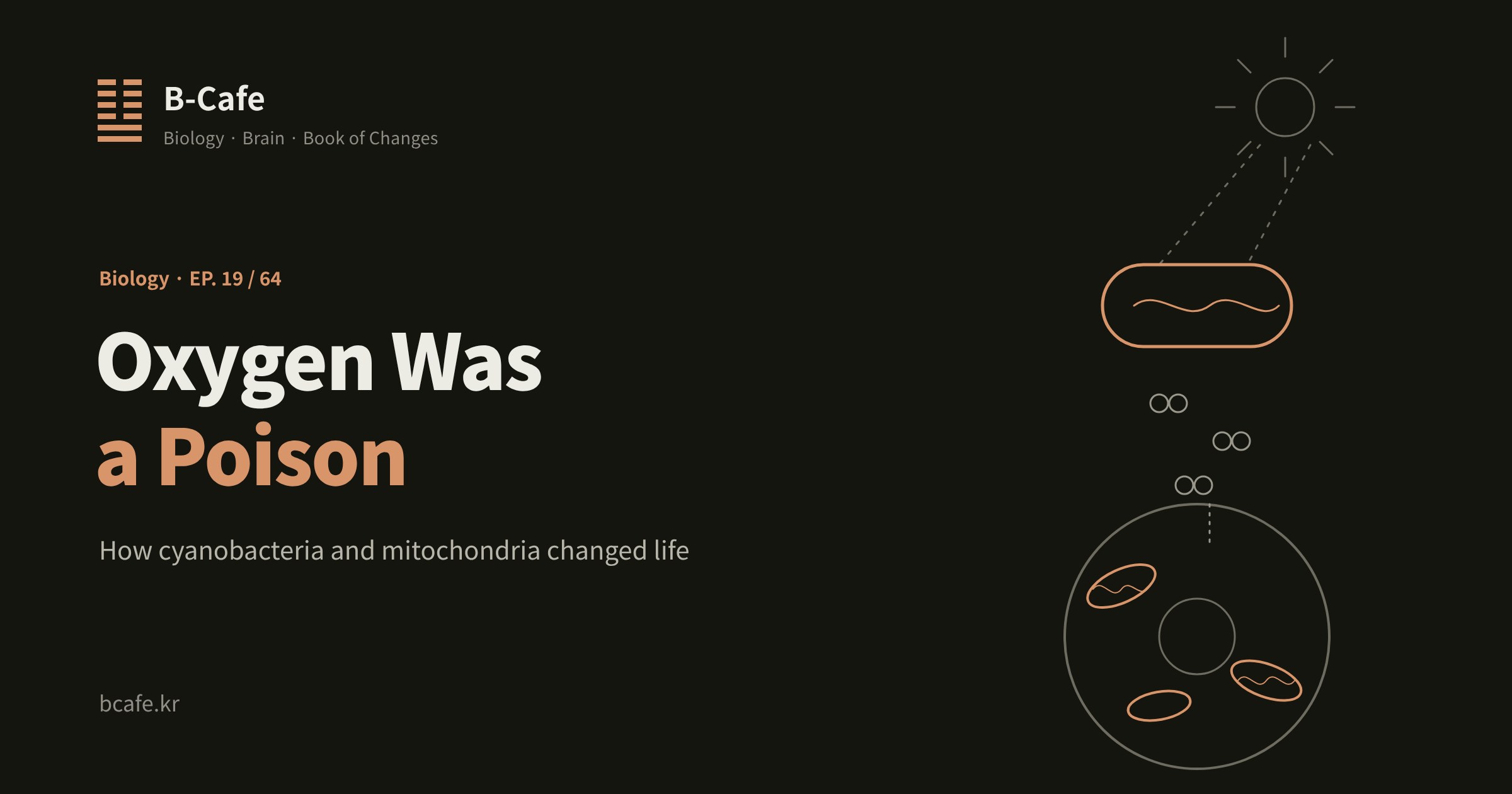
In the 1990s a Korean cosmetics advertisement made a catchphrase of “a woman like oxygen.”
Clear, clean, and impossible to live without — that was the compliment.
To a biochemist it is an odd one.
Oxygen rusts iron, turns oil rancid and wrecks the lipids of a cell membrane. A good part of ageing is oxidation.
The symbol of purity is one of the most persistent destroyers on this planet.
Meeting oxygen while making a film that has to disappear
I once wrote patents while developing a biodegradable mulching film — a sheet laid over crop rows that must vanish into the soil when the season ends.
The opponent I wrestled with longest in that work was oxygen.
Polymer chains exposed to sunlight break where oxygen meets them. Break too fast and the film crumbles before the crop is grown; too slowly and it is still lying in the field after harvest.
Oxygen always takes apart what has been built. The question is when you let it.
This piece is about the day that oxygen first appeared on this planet.
A world without oxygen came first
The atmosphere of the cooling young Earth held almost no oxygen. Nitrogen and carbon dioxide dominated, and volcanoes vented sulfur compounds.
How little there was is written in rock.
In 2002 Pavlov and Kasting analysed a sulfur-isotope signal in ancient sediments that survives only under an almost oxygen-free sky. Their conclusion:
Before the Great Oxidation Event, atmospheric oxygen was below one hundred-thousandth of today’s level.
The first life started under those conditions, with metabolisms that run without oxygen. Microbes that die on contact with oxygen still live deep underground and in animal guts. They are descendants of that age.
Cyanobacteria — the bacterium that split water
What broke the balance was a very small bacterium.
Cyanobacteria, also called blue-green bacteria.
They used light energy to split water molecules, taking electrons from water to turn carbon dioxide into sugar. Splitting water leaves oxygen atoms behind; they pair up as oxygen molecules and leave the cell.
Oxygen was not the goal. It was what was left over after using light.
Splitting water is an extremely hard reaction. The enzyme complex that does it exists only in cyanobacteria and in the chloroplasts of plants and algae, which are their descendants taken inside. Almost all of the oxygen in Earth’s air came from this one machine.
The sizes make it stranger. Here is the scale this site uses throughout, magnified five million times.
| Object | Actual size | ×5,000,000 |
|---|---|---|
| One cyanobacterium | about 1–2 μm | 5–10 m |
| A human cell | 10 μm | a 50 m dome |
| Mitochondrion, width | about 0.5–1 μm | 2.5–5 m |
A five-metre bacterium changed what the sky is made of.
At first, oxygen could not reach the sky
The sky did not change the moment cyanobacteria began releasing oxygen.
Seawater then carried dissolved iron. In oxygen-free water iron stays dissolved; when oxygen arrived the iron combined with it into rust-like grains that sank to the floor.
What piled up is the banded iron formation — rock in which red and grey bands alternate for hundreds of metres.
Oxygen that should have gone to the sky stayed as red stripes under the sea.
Much of the iron ore people mine today comes from these strata. We are mining the grave of oxygen that was swallowed as fast as it was made, for hundreds of millions of years.
The Great Oxidation Event — about 2.4 billion years ago, and what “about 1 percent” means
Then came a time when sea and rock could no longer swallow it all.
The Great Oxidation Event (GOE).
By the 2021 synthesis of Poulton’s group it began about 2.43 billion years ago, and it did not end at once. Oxygen rose and fell repeatedly and became permanent in the atmosphere only about 2.22 billion years ago — around 200 million years from start to settlement.
A common line here is that “oxygen became 1 percent of the air.” It needs correcting.
| Phrase | What it actually means |
|---|---|
| “oxygen at about 1%” | about 1% of today’s atmospheric level (an estimate with a wide range) |
| Oxygen in today’s air | about 21% |
| So oxygen as a share of the air then | roughly 0.2% |
Even 1 percent of today’s level was thousands of times more than before. It was enough.
Was the oxygen catastrophe really a mass extinction?
The event is also called the “oxygen catastrophe”, because for organisms that could not tolerate oxygen the whole sky had turned toxic.
Why oxygen is toxic is a matter of chemistry. It pulls electrons from other molecules very hard. When it takes electrons only partially inside a cell it forms reactive oxygen species, which attack lipids, proteins and DNA. In 1954 Gerschman’s group proposed that high-oxygen toxicity and radiation damage arise from the same radical mechanism.
But “mass extinction” needs qualifying.
- Life then was almost entirely microbial and fossilises poorly
- Organisms that retreated from oxygen to oxygen-free places are still alive today
- So the scale of the damage is an estimate, not something confirmed in fossils
What is certain is the direction. The chemistry of Earth’s surface never went back.
The bacterium that did not run
Most fled oxygen.
Some bacteria did the opposite. They breathed it in and used it to burn their food.
Respiration.
One number shows the difference.
| Route | ATP per glucose |
|---|---|
| Fermentation (no oxygen) | 2 |
| Respiration with oxygen | about 30 |
Textbooks often say 36–38, but recalculating the respiratory chain’s proton budget gives about 30. Still fifteen times more.
It was poison. But burned, it gave power beyond anything before.
The cell that did not expel the intruder
What happened next changed the rules of life.
One oxygen-burning bacterium ended up inside a larger cell. Whether it was swallowed or got in on its own is unknown. Ordinarily it would have been digested.
It survived. It kept burning oxygen inside its host, and the host did not give up that energy.
This is endosymbiosis. Lynn Margulis (then Lynn Sagan) set it out in 1967 against fierce opposition. It is now the consensus, because the evidence is still inside us.
- Mitochondria carry their own circular DNA
- They have bacterial-type ribosomes, different from the cell’s own
- They multiply by splitting in two, as bacteria do
The host is being identified too. In 2020 Imachi’s group, after twelve years of culturing, isolated for the first time an Asgard archaeon, the lineage thought to have supplied the eukaryotic host.
A single liver cell holds 1,000–2,000 mitochondria. In the 50-metre dome, more than a thousand power stations of 2.5–5 metres are floating.
What changed was not size but possibility
What did taking in mitochondria change?
In 2010 Nick Lane and Bill Martin argued this. Bacteria make energy at the membrane on their surface. As a body grows, volume outpaces surface and energy runs short. Mitochondria broke that limit by laying hundreds or thousands of power stations inside the cell. The energy available per gene rose enormously, making large genomes and complex structures possible.
Animals, plants, fungi — every organism we can see with our eyes descends from this event.
If cyanobacteria overturned the air, the mitochondrion’s ancestor overturned the fate of the cell.
What is still unknown
- When did cyanobacteria appear? Some argue oxygenic photosynthesis preceded the GOE by hundreds of millions of years; others that it arose just before
- Why did it take so long? Whether the delay between making oxygen and accumulating it came from iron and volcanic gases or from a late origin of photosynthesis is not settled
- When did mitochondria arrive? Whether the host was already complex, or became complex because mitochondria arrived, is still debated
The definition this piece fixes
Set it down here.
Life crossed from a thing that flees oxygen to a thing that tames it. The threshold was not chemistry but cohabitation.
The poison was not removed. An organ that burns it was taken inside.
That is why this piece’s hexagram is Rim, 臨. Earth above the lake: the water below approaches the land above. The side that approached instead of fleeing won.
And the choice could not be undone. Cyanide blocks the last enzyme of the mitochondrial respiratory chain. With oxygen everywhere in the body but no way to burn it, a person lasts only minutes.
Summary
- Oxygenic photosynthesis began with cyanobacteria. Oxygen was a by-product of using light
- The first oxygen combined with iron in seawater and sank as banded iron formation
- Before the GOE, atmospheric oxygen was below 10^-5 of today’s level
- The GOE began about 2.43 billion years ago and became permanent about 2.22 billion years ago
- “About 1 percent” means about 1 percent of today’s level — roughly 0.2 percent of the air — not 1 percent of the air
- The scale of the “oxygen catastrophe” is an estimate, not a fossil-confirmed fact
- Respiration yields about 30 ATP per glucose; fermentation yields 2
- Mitochondria descend from oxygen-burning bacteria; their own DNA and bacterial ribosomes are the evidence
- Mitochondria raised the energy available per gene, making complex cells possible
This piece is rebuilt for search readers from “Cyano” of the serial essay The Great Corona Swindle. The development of the biodegradable film is the author’s own experience; the mechanisms and figures have been reset against primary literature.
Definitions
- Great Oxidation Event (GOE)
- The interval about 2.43–2.22 billion years ago when oxygen first accumulated in Earth's atmosphere in meaningful amounts.
- Banded iron formation
- Rock in which iron dissolved in seawater precipitated on meeting oxygen, leaving alternating red and grey bands — the record of oxygen consumed in the sea before it could reach the air.
- Endosymbiosis
- One cell living inside another as a partner. Mitochondria and chloroplasts arose this way.
Frequently asked
- Why is oxygen a poison?
- Oxygen pulls electrons away from other molecules very strongly. When it is reduced incompletely inside the body it forms reactive oxygen species, which damage lipids, proteins and DNA. In 1954 Gerschman's group proposed that oxygen toxicity and radiation damage share one mechanism: reactive radicals. Rusting metal is the same oxidation.
- When did the Great Oxidation Event happen?
- It began about 2.43 billion years ago but did not finish at once. In 2021 Poulton's group reported that oxygen rose and fell repeatedly and settled permanently in the atmosphere only about 2.22 billion years ago — roughly 200 million years from onset to permanence.
- Was there a mass extinction at the GOE?
- It is often called the 'oxygen catastrophe', but there is almost no fossil record showing its scale. Life then was almost entirely microbial and fossilises poorly. That oxygen-intolerant anaerobes were pushed into oxygen-free refuges is borne out by where such organisms live today; the size of any 'extinction' is an estimate.
- Were mitochondria originally bacteria?
- Yes. Lynn Margulis (then Lynn Sagan) set out the endosymbiotic theory in 1967, and it is now the consensus that mitochondria descend from an alphaproteobacterial ancestor. Mitochondria keep their own DNA and ribosomes and multiply by splitting in two, as bacteria do.
References
- Lyons, T. W., Reinhard, C. T., Planavsky, N. J. (2014). The rise of oxygen in Earth's early ocean and atmosphere. Nature, 506, 307–315. — Review of early Earth oxygenation, from trace levels to today's ~21 percent, with its uncertainties.
- Pavlov, A. A. & Kasting, J. F. (2002). Mass-independent fractionation of sulfur isotopes in Archean sediments: strong evidence for an anoxic Archean atmosphere. Astrobiology, 2(1), 27–41. — Sulfur isotopes constrain pre-GOE oxygen to below 10^-5 of present levels.
- Poulton, S. W., Bekker, A., Cumming, V. M., Zerkle, A. L., Canfield, D. E., Johnston, D. T. (2021). A 200-million-year delay in permanent atmospheric oxygenation. Nature, 592, 232–236. — Oxygen fluctuated from about 2.43 Ga and became permanent about 2.22 Ga.
- Fischer, W. W., Hemp, J., Johnson, J. E. (2016). Evolution of oxygenic photosynthesis. Annual Review of Earth and Planetary Sciences, 44, 647–683. — The debate over when oxygenic photosynthesis arose. The timing is not settled.
- Gerschman, R., Gilbert, D. L., Nye, S. W., Dwyer, P., Fenn, W. O. (1954). Oxygen poisoning and x-irradiation: a mechanism in common. Science, 119(3097), 623–626. — Oxygen toxicity and radiation damage share a radical mechanism.
- Sagan, L. (1967). On the origin of mitosing cells. Journal of Theoretical Biology, 14(3), 225–274. — Lynn Margulis (then Sagan) on endosymbiosis.
- Imachi, H. et al. (2020). Isolation of an archaeon at the prokaryote–eukaryote interface. Nature, 577, 519–525. — First culture of an Asgard archaeon, the lineage thought to have supplied the eukaryotic host.
- Lane, N. & Martin, W. (2010). The energetics of genome complexity. Nature, 467, 929–934. — Mitochondria greatly raised the energy available per gene, making complex cells possible.
- Rich, P. R. (2003). The molecular machinery of Keilin's respiratory chain. Biochemical Society Transactions, 31(6), 1095–1105. — ATP yield from the respiratory chain's proton budget. The textbook 36–38 overstates it; about 30 is the current figure.
Published October 28, 2026