The Brake Is What Makes It Fast — Negative Feedback, the Pulse of p53, and a Brake Released on Purpose
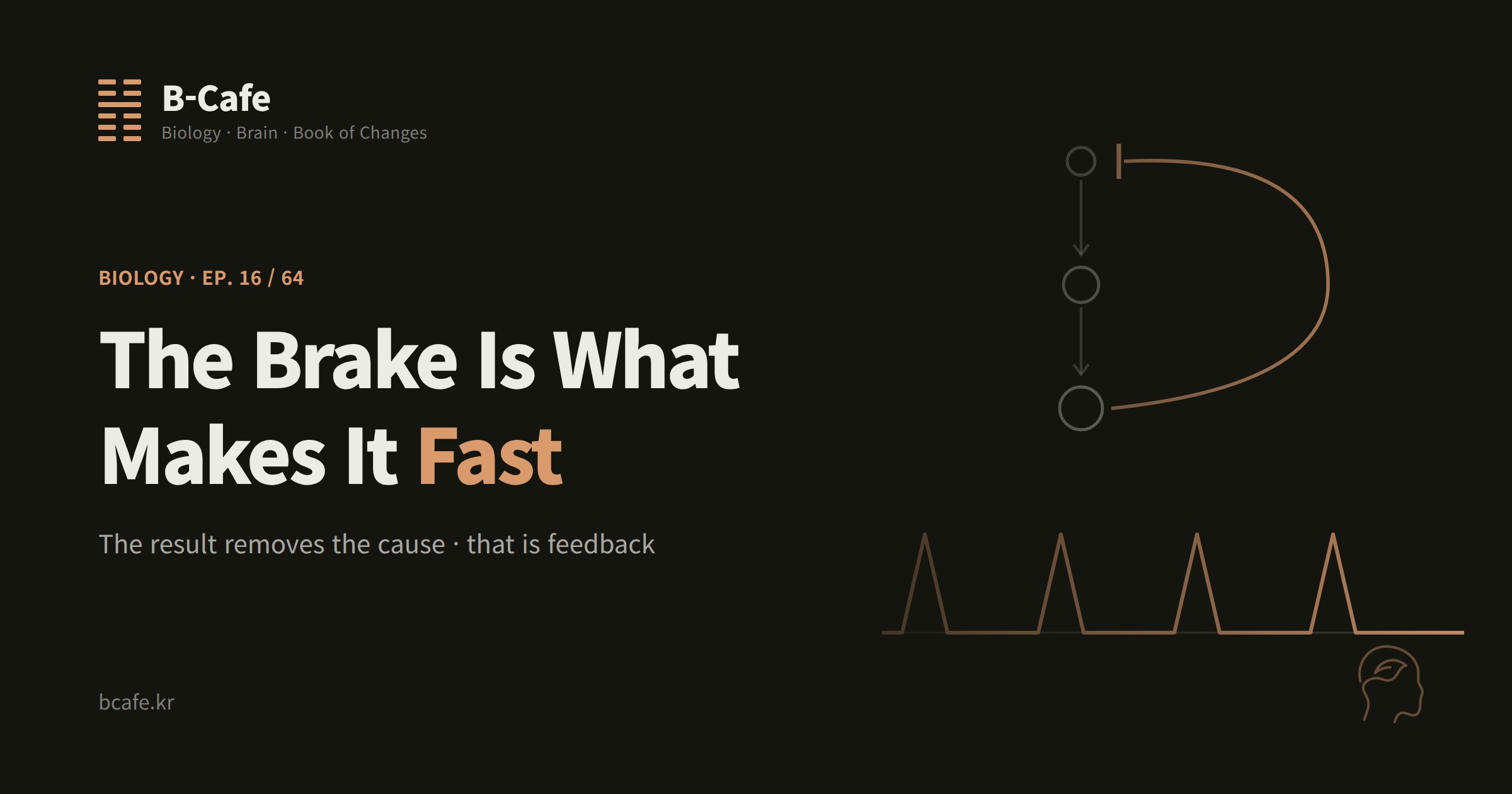
The result removes the cause. That is what feedback is. A brake is not a device for going slower. It is what allows the pedal to go down hard.
There was a young soldier who shot a man, was promoted two ranks, and flew home on leave by helicopter.
An armed infiltration incident. He pulled the trigger from several hundred metres out, and his twenties opened in triumph.
I envied him enough that for a while I used the word sniper as a kind of nickname.
Thirty years later I met him again. He was the guard at the entrance of an institution, after taking early retirement.
His eyes were calm. More precisely, they were empty.
Something in his life looked to have come back round and stopped him.
The result had removed the cause.
What I can say about one man’s eyes
A line first. I cannot diagnose him. What I saw that day was a pair of eyes and a short greeting.
What has accumulated is research on what killing in combat leaves behind.
In 2009 Litz’s group proposed moral injury: damage distinct from the terror of threatened life, left when what one did oneself collides with one’s own ethics. The cause is the act, not the fear.
The same year Maguen’s group reported that in veteran data, after statistically adjusting for degree of combat exposure, the experience of killing remained separately associated with later symptoms.
Whether that was what I saw, I do not know. What this piece marks is something else. A result coming back round to erase its own cause is not a figure of speech that belongs to people alone.
Biology calls this negative feedback
Negative feedback. The output suppresses the input.
Back to the dome 50 metres across.
A telegram arrives from outside: grow. A receptor on the membrane catches it. Inside, phosphate groups — small charges — attach and detach on proteins, passing the order along in milliseconds.
Amplifiers light up in sequence and reach the nucleus. A door opens. Divide.
So it accelerates. And once amplification passes a level, an inspector appears.
| Situation | The brake applied |
|---|---|
| Amplification overshoots | a lock goes onto the device that started it |
| DNA is damaged | work halts and repair is ordered |
| Repair impossible | the dome shuts itself down |
The brake is what makes it fast
Here the intuition inverts.
A brake looks like a device for going slower. It is not.
In 2002 Rosenfeld, Elowitz and Alon compared two circuits in E. coli: one repressing its own expression, one without that repression. Final concentrations were matched.
The one with the brake reached that concentration faster.
The reason is plain. Without repression you must push gently from the outset to land on target. With it you push hard, and ease off as you approach.
The brake is what lets the pedal go down. Feedback is not the opposite of speed. It is the condition for it.
It does not switch off — it beats
Feedback sounds as though it should drive a signal to zero. Often it does not.
DNA damage raises p53. And p53 induces MDM2, the protein that degrades it. Going up switches on the device that brings it down.
In 2004 Lahav’s group watched this loop in individual cells.
p53 did not make a flat plateau. It made a pulse at regular intervals.
The number of beats differed between cells; their height and width were similar. The size of the damage changed the count, not the amplitude.
Feedback does not erase a signal. It turns a signal into a rhythm.
What it becomes when released
Three conditions branch from the same point.
| Brake released | What it becomes |
|---|---|
| A growth signal that never switches off | proliferation that does not stop |
| Inflammation that never switches off | sepsis |
| Immunity that does not stop at self | autoimmunity |
For sepsis it is written into the definition. The 2016 international consensus defines it as life-threatening organ dysfunction caused by a dysregulated host response to infection.
Not how strong the pathogen is. Whether the feedback failed is in the definition.
Autoimmunity has a dedicated force against it. The regulatory T cells identified by Sakaguchi’s group in 1995 — cells whose whole job is stopping the attack.
Life engineered the brakes more finely than the accelerator.
And a drug releases that brake on purpose
To the pharmacy side of this.
T cells carry receptors that brake excessive attack: CTLA-4 and PD-1. Tumours exploit that brake to avoid being hit.
In 1996 Leach, Krummel and Allison blocked CTLA-4 and antitumour immunity strengthened. PD-1 had been discovered in 1992 by Honjo’s group. The two shared the 2018 Nobel Prize in Physiology or Medicine.
An immune checkpoint inhibitor does not attack the tumour. It releases the brake on your own side.
The cost arrives with it. Postow’s 2018 NEJM review set out the range: skin, gut, liver, lung, thyroid, pituitary. Immunity with the brake off does not confine itself to the tumour.
Immune-related adverse events. Rates vary widely by agent and by whether drugs are combined, but counting any grade, a substantial proportion of patients experience them.
Justice without a brake is another runaway.
A rare case where the effect and the adverse effect are two faces of one mechanism. There is no way to reduce one without the other.
This article’s definition
Fixed here.
Feedback is the structure by which a result removes its own cause.
And one line more. Feedback is not the price paid for giving up acceleration. It is what made the acceleration possible.
The hexagram here is 豫. 「雷出地奮」 — thunder bursts out of the earth, the image of something held below breaking out: amplification.
And 豫 means made ready in advance. A brake is not built after the runaway. It is built alongside the accelerator. Amplification and braking inside one figure.
Monologue of one among 1031
A sniper does not move. Exposure is death.
Two days, three days, held still and breathing shallow. Not moving until the silence settles and the watch loosens. Whoever moves first is seen first.
Then one shot. Several hundred metres out, with a margin of a few centimetres. The sound is short and the result is long.
I am the same.
I choose silence over amplification.
Between the threads wound on histones, under the shadow of the nucleosome, I stay folded. This is not a figure of speech: a latent viral sequence really does sit in closed chromatin and go untranscribed. What is not read is not seen.
While the alarms are sounding I do not move. Nor while the production lists outside are crowded.
I wait. For the cell to start trusting itself. For the inspector to relax. For the feedback to run late.
I erase the marks. I leave the records blank. The army outside the dome does not see.
The runaway is not mine to make. The runaway is already inside them.
A sniper shoots at the moment the target starts to run. I shoot at the moment the feedback is late.
The silence is long and the shot is short.
Life is briefly, repeatedly, too sure of itself.
That gap is my range.
In short
- Negative feedback is a structure in which the output suppresses the input. The result removes the cause
- A self-repressing circuit reaches the same level faster. The brake is what lets the pedal go down
- p53 induces MDM2 and MDM2 degrades p53. The result is a pulse, not an off switch
- The size of the damage changed the number of beats, not their height
- The international definition of sepsis contains the words dysregulated host response
- Regulatory T cells exist solely to stop the attack
- Checkpoint inhibitors release the CTLA-4 and PD-1 brakes to strengthen the attack
- The same mechanism produces immune-related adverse events. Neither can be reduced alone
- A latent virus sits in closed chromatin and goes untranscribed. What is not read is not seen
- 豫 means made ready in advance. The brake is built alongside the accelerator
This piece is rebuilt for search readers from “Feedback” of the serial essay The Great Corona Swindle. The memory of the sniper is the author’s own, and no particular individual is diagnosed here. The mechanisms and figures have been reset against primary literature.
Frequently asked
- Does negative feedback slow things down?
- The opposite. In 2002 Rosenfeld, Elowitz and Alon showed experimentally that a gene circuit repressing its own expression reaches a given final concentration faster than one without that repression. Without the brake you have to push gently from the start to land on target; with it you push hard and ease off as you approach. The brake is what lets the pedal go down.
- Does feedback switch the signal off?
- Often it makes it oscillate instead. DNA damage raises p53, and p53 induces MDM2, which degrades p53. The two push against each other and the concentration becomes a pulse at regular intervals rather than a plateau. Lahav's group watched these beats in individual cells in 2004.
- What happens when feedback is released?
- A growth signal that never switches off means proliferation that never stops. Inflammation that never switches off becomes sepsis — defined in 2016 as life-threatening organ dysfunction caused by a dysregulated host response to infection. Immunity that does not stop at self becomes autoimmunity. None of the three is a problem of firepower. All three are problems of braking.
- How do immunotherapy drugs work?
- T cells carry receptors that brake excessive attack: CTLA-4 and PD-1. A checkpoint inhibitor blocks that braking signal and releases the brake temporarily. Leach, Krummel and Allison showed in 1996 that blocking CTLA-4 strengthens antitumour immunity, work that led to the 2018 Nobel Prize. The cost arrives with it: immune-related adverse events, in which the released immunity attacks the patient's own tissue.
References
- Rosenfeld, N., Elowitz, M. B., Alon, U. (2002). Negative autoregulation speeds the response times of transcription networks. Journal of Molecular Biology, 323(5), 785–793. — Measured shortening of response time by self-repression. The brake makes it fast.
- Alon, U. (2007). Network motifs: theory and experimental approaches. Nature Reviews Genetics, 8(6), 450–461. — Recurring feedback structures in biological circuits and what they do.
- Lahav, G. et al. (2004). Dynamics of the p53-Mdm2 feedback loop in individual cells. Nature Genetics, 36(2), 147–150. — p53 appearing as regular pulses rather than switching off, seen cell by cell.
- Cannon, W. B. (1929). Organization for physiological homeostasis. Physiological Reviews, 9(3), 399–431. — The establishment of homeostasis as a concept.
- Singer, M. et al. (2016). The Third International Consensus Definitions for Sepsis and Septic Shock (Sepsis-3). JAMA, 315(8), 801–810. — Sepsis defined as a dysregulated host response.
- Sakaguchi, S. et al. (1995). Immunologic self-tolerance maintained by activated T cells expressing IL-2 receptor alpha-chains (CD25). Journal of Immunology, 155(3), 1151–1164. — Identification of the T cells whose job is stopping the attack on self.
- Leach, D. R., Krummel, M. F., Allison, J. P. (1996). Enhancement of antitumor immunity by CTLA-4 blockade. Science, 271(5256), 1734–1736. — First demonstration that blocking a braking receptor strengthens antitumour immunity. Nobel Prize, 2018.
- Ishida, Y., Agata, Y., Shibahara, K., Honjo, T. (1992). Induced expression of PD-1, a novel member of the immunoglobulin gene superfamily. EMBO Journal, 11(11), 3887–3895. — The discovery of PD-1.
- Postow, M. A., Sidlow, R., Hellmann, M. D. (2018). Immune-related adverse events associated with immune checkpoint blockade. New England Journal of Medicine, 378(2), 158–168. — The range and frequency of what follows from releasing the brake.
- Litz, B. T. et al. (2009). Moral injury and moral repair in war veterans: A preliminary model and intervention strategy. Clinical Psychology Review, 29(8), 695–706. — A model of the damage left by one's own acts in combat, distinct from fear.
- Maguen, S. et al. (2009). The impact of reported direct and indirect killing on mental health symptoms in Iraq war veterans. Journal of Traumatic Stress, 22(5), 435–443. — Killing associated with later symptoms after adjusting for combat exposure.
- Van Lint, C., Bouchat, S., Marcello, A. (2013). HIV-1 transcription and latency: an update. Retrovirology, 10, 67. — How a latent provirus stays silent inside closed chromatin.
Published October 6, 2026