The Signal Beneath the Caption — The One That Keeps Coming
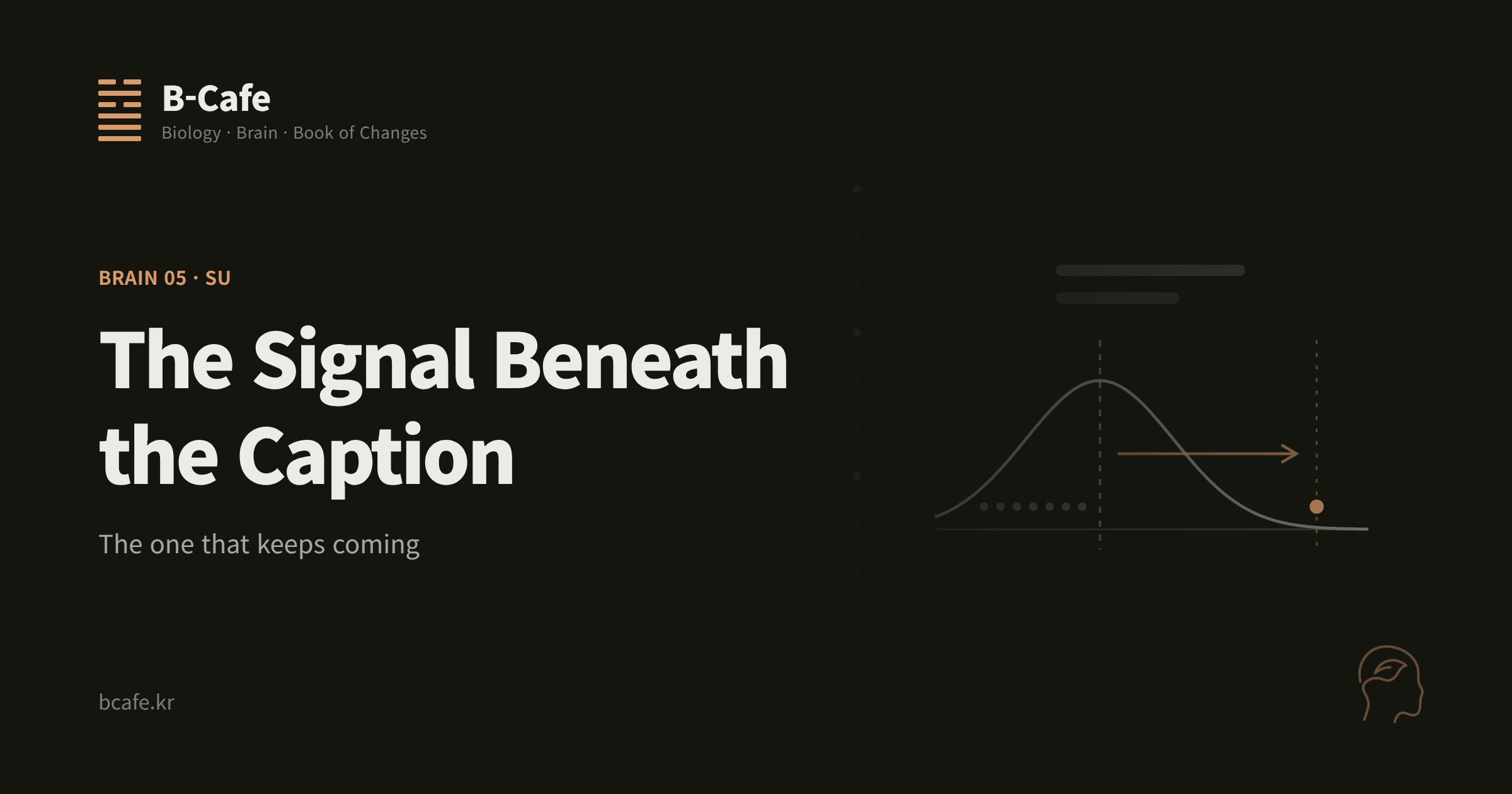
Where most of them stop, one keeps going. That is not will; it is the tail of a threshold distribution. Intuition is not the ability to hit the average. It is the refusal to shave off the tail.
There are two dogs on the morning road to the temple.
The white one is fierce and always tied. The black one is small and young. Some days its lead is off. On those days it falls in beside me and wags — it wants food.
At the stream at the end of the road I collect earthworms. Sunglasses are equipment there. Without them small flies settle at the corners of the eyes.
And there is a boundary.
Past a certain point neither the dog nor the flies follow. No line is drawn on the ground and no one gave an order. They stop there.
Where that line actually is, is today’s subject.
The line is not on the ground. It is in the gradient
Start with the insects.
A small fly finds a person by climbing a concentration gradient.
| Cue | Source |
|---|---|
| Carbon dioxide | Breath |
| Body odour compounds | Skin, sweat |
| Humidity | Water, tears, sweat |
| Heat, a moving outline | The body |
Tracking means moving in the direction where this grows stronger. So what matters is less the concentration than the slope.
What happens away from the water?
Humidity falls toward background, wind mixes the plume, the slope disappears. The directional information is gone.
Nothing was hit. There is simply nothing left to follow. Which is why they appear to turn back in unison.
The boundary is not in the ground but at the point where the signal sinks into background.
The dog is a different mechanism
A dog’s stopping does not fold into the same account. There are two candidates, and they can be told apart.
| Candidate | Content | Test |
|---|---|---|
| Home-range core | Where its scent marks meet a neighbour’s | Food beyond the line and it still stops |
| Learned boundary | A place where it was checked or hurt | Food beyond the line and it crosses |
Burt drew the distinction between home range and territory in 1943: the area regularly used is not the area defended.
The dog the author describes begs for food. That makes an experiment available. Put food one step past the line and the two hypotheses separate on the spot.
Why the distinction matters. A line drawn on a scent map and a line drawn in memory are not the same object. Collapsing them gives an impression rather than an explanation.
The one that keeps coming
This is where the author stops. Most turn back and one comes further.
There is an account of this too.
Social-insect research uses a response threshold model.
The structure is simple.
| Stimulus strength | Falls with distance |
| Individual threshold | The level at which responding starts |
| Behaviour | Continues only while stimulus > threshold |
What decides everything here is that threshold is not a single value.
Within one group, thresholds form a distribution.
In 1996 Bonabeau, Theraulaz and Deneubourg showed quantitatively that this variance produces division of labour. Low-threshold individuals respond first to a weak stimulus; high-threshold ones move only when it strengthens. That difference alone splits the roles.
So what is the one the author watched?
| Account | |
|---|---|
| Most stop | Thresholds cluster near the mean. Pattern |
| One comes further | That individual sits in the tail. Exception |
Not will. The far end of a distribution.
This does not weaken the piece. It makes the author’s conclusion load-bearing.
The tail is not a defect. A distribution without a tail means the group is wrong all at once when the environment shifts.
If no one ever goes past the line where most stop, what lies past it is never known.
Only a group with a tail can move the line. Threshold variance is not waste. It is insurance.
What it means to be buried in the average
The author defines intuition as the power to notice the small deviation from the average first.
Rewritten in the structure above:
Intuition is a way of processing that does not discard the tail as an outlier.
Statistics shaves tails. That is its job. Summarise with a mean and a variance and the tail becomes error.
What a machine learns is that summary. The pattern lives at the centre of the distribution, and machines find centres well.
So the room left for people is not there.
| Good at | |
|---|---|
| Machine | The centre. Summary. Pattern |
| Human | Being uncomfortable in front of a tail |
The feeling of “that’s odd” is a signal that unsummarised data is still present. Erase it quickly and only the summary remains.
The caption is late — stated precisely
The author writes that a judgement was never a judgement: the direction is set below, and only the result surfaces as a single line.
The direction is right and the strength needs care.
| Claim | Status |
|---|---|
| Conscious report lags neural activity | Repeatedly observed |
| That activity is a “decision” | Contested |
| Schurger’s 2012 reading | Accumulating noise crossing a threshold |
In Schurger’s model the readiness potential is not a decision already made but noise fluctuating near a threshold. The moment the fluctuation happens to cross is when movement occurs.
That meshes with today’s piece. Here too it is a threshold. As thresholds vary between individuals in an insect group, within one person they vary over time. The same person stops today and crosses tomorrow.
Stated honestly: that the caption is late is an observation; who holds the wheel beneath it is not settled.
That sentence of Jobs’s
Fixing the source of the line the author quotes.
Stanford University commencement, 12 June 2005.
“Have the courage to follow your heart and intuition.”
In circulation it is often read as “live by your feelings.” That is not the context. The lines around it are about not being buried under other people’s expectations.
Moved into today’s structure, it reads exactly:
Do not let the average shave off your tail.
The hexagram of this piece
需. Heaven (乾) below, water (坎) above.
The image reads 雲上於天 需 君子以飮食宴樂 — clouds have risen into the sky; the noble one eats and drinks, feasts and is glad.
The clouds are up and the rain has not come. The work is not to hurry the rain. It is to stay unspent until it does.
That the hexagram of waiting names eating and resting as the work is the point. Waiting is not endurance. It is not spending yourself.
The Sequence places 需 after 蒙.
物穉不可不養也 故受之以需 需者飲食之道也
What is young cannot go unnourished. So Xu receives it. Xu is the way of food and drink.
| Episode | Hexagram | The position |
|---|---|---|
| 3 | 屯 | Cannot break through alone, so takes the other inside |
| 4 | 蒙 | Not yet clear; crosses only when asked |
| 5 | 需 | Not drawing the conclusion early; nourishing instead |
What the author calls “not concluding immediately” is the content of 需 itself.
The definition this piece fixes
Fixed here.
The signal beneath the caption
What set a direction before it became words: smell, damp, the body’s tension, the memory of having been fooled.
Seen at the level of a group, it is the tail of a threshold distribution — whatever is still responding beyond the line where most have stopped.
Intuition is a way of processing that does not shave that tail down to the average.
Machines learn the centre. The tail is still ours.
Monologue of 1031 intruders
We do not move by averages.
Of us that enter a host, most fail. Caught by immunity, no receptor found, cut off mid-replication. That is the centre.
What survives sits at the far end. The ones whose sequence was slightly off. The ones that attached where the others could not.
For us mutation is not an accident. It is the work of making a tail.
You do the reverse. You erase the deviation first. If statistics misses it you record it as absent; if it resists explanation you record it as mood. That keeps the summary clean.
A clean summary is useful only while the environment holds still.
A few of you do not erase. They stand past the line where the rest turned back, uncomfortable, and carry the discomfort all the way.
You write that they left their names on an age.
We write it differently. They were the tail of a distribution. And the line has only ever moved from the tail.
In brief
- The invisible boundary is in the gradient, not the ground. When the slope sinks into background, direction itself is gone
- A dog’s stopping has two candidates — home-range core and learned boundary — separable by placing food beyond the line
- Most of a group stopping together reflects thresholds clustered near a mean
- The one that keeps coming is the tail of the threshold distribution. Variance, not will (Bonabeau et al. 1996)
- A group without a tail is wrong all at once when the environment shifts. Threshold variance is insurance, not waste
- Machines learn the centre of the distribution. Being uncomfortable in front of a tail is left to people
- That the caption is late is an observation; who holds the wheel beneath it is not settled (Schurger 2012)
- Jobs’s line is from the Stanford commencement of 12 June 2005. It is not an instruction to live by feeling
- 需 is the hexagram of waiting, and the work its image names is eating and resting. Waiting is not endurance but not spending yourself
This is the fifth piece in the “Brain” chapter of the serial essay The Great Corona Swindle. The observations of the dog and the flies are the author’s own; the behavioural ecology and neuroscience have been reset against primary sources. No individual health advice or diagnosis is offered here.
The next piece is “Where the Line Moves”.
Frequently asked
- Why do most individuals stop at the same point?
- Because stimulus strength falls with distance and each individual has a threshold at which it begins to respond. The response-threshold model used in social-insect research describes this structure: an individual acts while the stimulus exceeds its threshold and stops when it falls below. If thresholds cluster around a mean, most individuals turn back at a similar point.
- Then what is the one that keeps coming?
- The tail of the distribution. Within a single group, thresholds are not one value but a spread. An individual with a low threshold keeps responding to a weakened stimulus and so continues after the others have stopped. In 1996 Bonabeau, Theraulaz and Deneubourg showed quantitatively that this variance is what produces division of labour. Not will — the far end of a distribution.
- With no line on the ground, what do insects read to turn back?
- Not a line but a gradient. Move away from water and humidity drops; move away from a host and carbon dioxide and body odour drop. Tracking works by climbing a concentration gradient, so when the gradient vanishes the directional information itself is gone. What looks like a boundary is the point where the signal sinks into background.
- Does the same explain an unleashed dog stopping?
- No. For a dog there are two candidates. One is the boundary of the home-range core, where its own scent marks meet a neighbour's and it goes no further. The other is a learned boundary — a place where it was checked or had an unpleasant experience. There is a field test: put food just beyond the line. If the dog crosses, a learned boundary is more likely; if it still stops, a core boundary is.
References
- Bonabeau, E., Theraulaz, G., Deneubourg, J.-L. (1996). Quantitative study of the fixed threshold model for the regulation of division of labour in insect societies. Proceedings of the Royal Society B, 263(1376), 1565–1569. — Variance in response threshold between individuals generates division of labour.
- Beshers, S. N. & Fewell, J. H. (2001). Models of division of labor in social insects. Annual Review of Entomology, 46, 413–440. — Overview and limits of the threshold family of models.
- Cardé, R. T. & Willis, M. A. (2008). Navigational strategies used by insects to find distant, wind-borne sources of odor. Journal of Chemical Ecology, 34(7), 854–866. — Odour-gradient tracking and behavior where the plume is lost.
- Gibson, G. & Torr, S. J. (1999). Visual and olfactory responses of haematophagous Diptera to host stimuli. Medical and Veterinary Entomology, 13(1), 2–23. — Carbon dioxide, body odour and humidity guide dipteran approach to a host.
- Burt, W. H. (1943). Territoriality and home range concepts as applied to mammals. Journal of Mammalogy, 24(3), 346–352. — The distinction between home range and territory; origin of the core-area concept.
- Schurger, A., Sitt, J. D., Dehaene, S. (2012). An accumulator model for spontaneous neural activity prior to self-initiated movement. PNAS, 109(42), E2904–E2913. — The readiness potential read as accumulating noise; why the conscious report comes late.
- Jobs, S. (2005). Commencement Address, Stanford University, 12 June 2005. — "Have the courage to follow your heart and intuition." Source and date.
Published October 12, 2026