Can Information Run Without a Body? The Waggle Dance and Seven Bits
What was in one bee's head is executed by another body. The sender dies; the vector that was delivered stays.
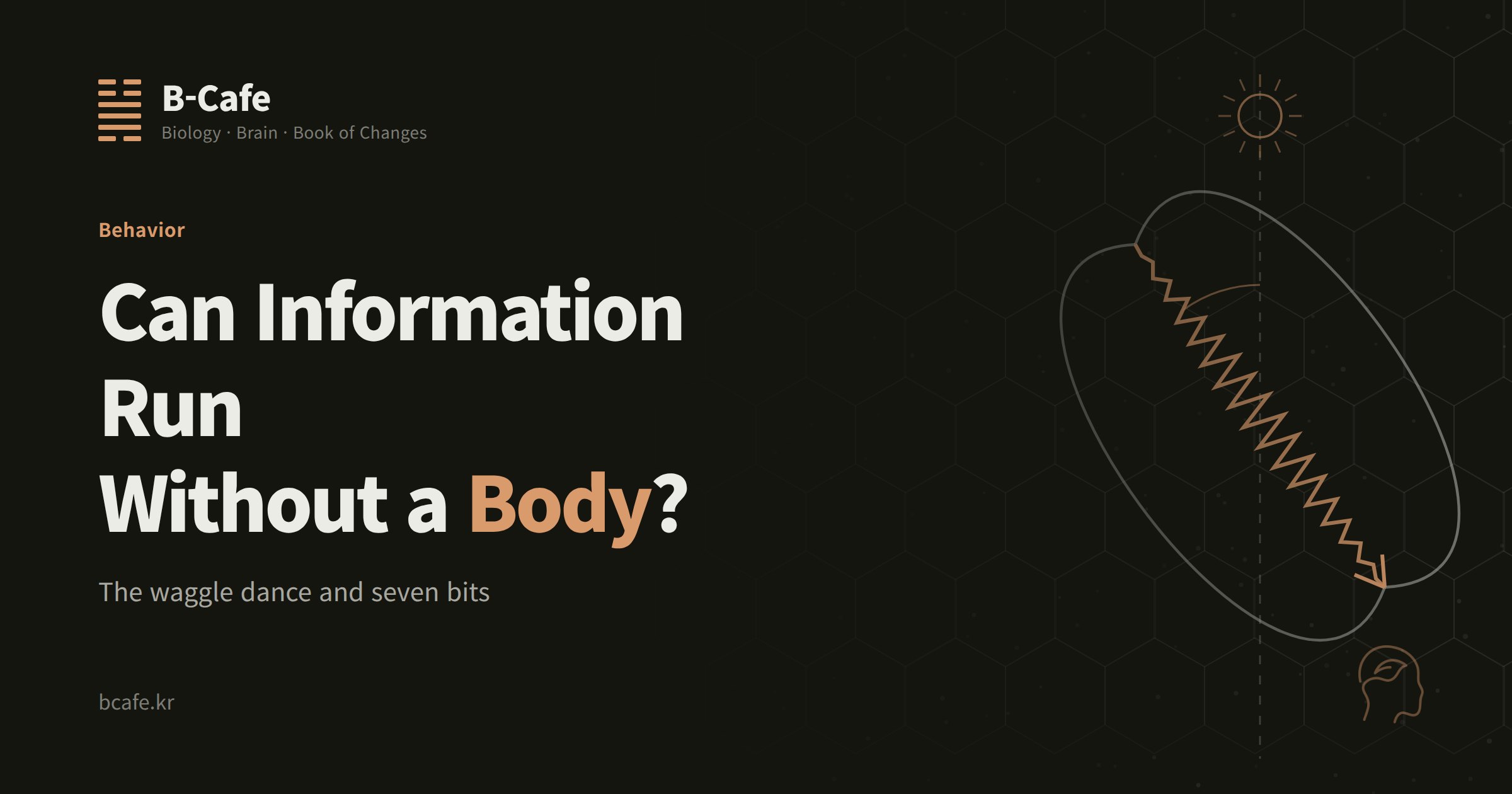
A bee finds a field of flowers.
She returns to the hive and dances. Soon after, she dies.
Bees that have never been there fly to the place.
What was in one head has been executed by other bodies.
In the dark, gravity stands in for the sun
The dance happens inside the hive. It is black in there and the comb is vertical. No sun is visible.
So it is substituted.
straight up = the direction of the sun
The straight stretch where the bee shakes her body as she advances is the waggle run. The angle of that straight line from vertical is the bearing to the flowers relative to the sun.
Tilted 40 degrees right of vertical means: outside, fly 40 degrees right of the sun.
Reading gravity as the sun. It is a whole change of coordinate frame.
One second is one kilometre
If the angle is direction, the distance is time.
The duration of the waggle run corresponds to flight distance, at roughly one second per kilometre. The figure varies with population and conditions; some measurements put a second closer to 750 metres.
| What is sent | The code | What it means |
|---|---|---|
| Direction | angle from vertical | bearing relative to the sun |
| Distance | duration of the straight run | about 1 s = 1 km |
| Quality of the find | repetitions and vigour | how many bees are recruited |
Von Frisch worked out the correspondence, and the 1973 Nobel Prize in Physiology or Medicine went to it.
Do they actually read it?
This was fought over for a long time.
Wenner and Wells argued the opposite: recruits follow odour, not the dance. The dance, on their account, expresses excitement, and the actual guidance comes from food scent and chemical cues at the site.
The argument ran from the 1960s for close to forty years. There were statistics showing that bees which watched a dance arrived at the target, but nobody had seen what those bees did on the way.
In 2005 that stretch was opened up.
Riley and colleagues fixed harmonic radar transponders to bees and tracked entire flight paths. Recruits flew the direction and the distance the dance had specified.
The dance was not an expression. It was a code.
Displace them and they fly the same vector
The same experiment produced something more important.
Bees that had watched a dance were caught and released at a different site.
From the new starting point they flew the same direction and the same distance the dance had specified. They arrived somewhere with no flowers at all.
What the bee read was a vector, not a coordinate.
Had a place been transmitted, a displaced bee would still have reached it. She did not. What was transmitted was “from here, that way, this far” — and changing the body did not change the instruction.
This experiment fixes what the unit of transmission is.
How many bits is one dance?
If it is a code, the information can be counted. Haldane and Spurway first attempted this in 1954.
This article’s calculation:
| Item | Resolution | Distinguishable | Bits |
|---|---|---|---|
| Direction | ±13° | about 14 | log₂14 ≈ 3.8 |
| Distance | 8–16 classes | 8–16 | 3–4 |
| Total | about 128 | about 7 bits |
A single Korean character takes three bytes in UTF-8 — 24 bits.
One waggle dance carries less than a third of one character.
Thousands of bees move on those seven bits. The question was never how much information. It was whether it executes.
The sender can die
Shannon’s 1948 definition of information contains no meaning. Information is measured only by how much uncertainty it removes, and what carried it is not part of the definition.
Independent of the medium means this. The paper can burn, the wire can be cut, the bee that danced can die; if it is reconstructed at the receiving end, the information is alive.
The body is finished and the movement continues.
People are no different. One sentence left by someone dead changes a living person’s judgement centuries later.
So how far does death reach? To the moment the body stops, or to the moment the last trace goes unread?
The errors are why it is not taxidermy
Genetic information is not buried with one body either. It passes to the next generation and is read again in a new one.
It is not copied perfectly. It mixes, it slips, it changes.
That error is not a defect. Had copying been perfect, everything would have died together the moment the environment moved.
Forever is not holding one body for a long time. It is the ability to start again in another.
Still unknown
That the dance is a code is settled. How it is read is not.
Inside a black hive a follower cannot see the dancer. Vibration, air flow and antennal contact appear to combine, but the reception pathway has not been fully worked out.
Recruitment efficiency is also lower than one might assume. Only a modest fraction of followers reach the target, and many end up relying on odour and cues at the site.
Wenner and Wells were not entirely wrong. What was wrong was the premise that it had to be one or the other.
This article’s definition
What can be transmitted is not a body. It is a vector.
If that is what has been called the soul, then it does not reside anywhere. It is read again.
While the question was “where is the soul”, no answer came. Change the question to “what gets executed again” and measurement begins — starting with a seven-bit code.
In short
- The waggle dance is performed on a dark vertical comb, with straight up substituted for the direction of the sun
- The angle from vertical is bearing; the duration of the run is distance, at roughly 1 s = 1 km
- Whether the dance or odour does the guiding was argued for forty years, and harmonic radar tracking settled it in 2005
- Displaced recruits flew the same vector from a new start point. What travels is a vector, not a coordinate
- One dance carries about 7 bits — less than a third of one Korean character at 24 bits
- In Shannon’s definition information is independent of its medium. The sending body can vanish and the information survives its reconstruction
- Copying error is not a defect. Without it everything would end together when conditions change
This piece is rebuilt for search readers from “Soul Transfer Code” of the serial essay The Great Corona Swindle. The original’s point of view is kept, and experimental grounds and figures have been added.
Frequently asked
- What does the honeybee waggle dance transmit?
- Direction and distance. On a vertical comb inside the dark hive, straight up stands in for the direction of the sun; the angle of the straight waggling run from vertical gives the bearing to the food relative to the sun. The duration of that run corresponds to flight distance, at roughly one second per kilometre.
- Do bees really find a place they have never visited from the dance alone?
- Yes, though it was long disputed. Wenner and Wells argued that recruits follow odour rather than the dance, an argument that ran from the 1960s onward. In 2005 Riley and colleagues tracked recruits' flight paths directly with harmonic radar and showed they fly the vector the dance specified.
- Does a bee learn a location or a heading and a distance?
- A heading and a distance. In the 2005 experiment recruits were captured after watching a dance and released at a different site. They flew the same direction and the same distance from the new site and arrived somewhere with no food. They had read a vector, not a coordinate.
- How much information does one waggle dance carry?
- About seven bits by this article's calculation. Taking angular error at ±13 degrees gives roughly 14 distinguishable bearings, or 3.8 bits; 8 to 16 distance classes gives 3 to 4 bits. Together that is one choice out of about 128. Haldane and Spurway (1954) were the first to analyse the dance in information-theoretic terms.
References
- von Frisch, K. (1967). The Dance Language and Orientation of Bees. Harvard University Press. — The decoding of angle and duration as direction and distance. Nobel Prize in Physiology or Medicine, 1973.
- Riley, J. R., Greggers, U., Smith, A. D., Reynolds, D. R., Menzel, R. (2005). The flight paths of honeybees recruited by the waggle dance. Nature, 435, 205–207. — Harmonic radar tracking of recruits. Displaced bees flew the same vector from the new release point.
- Wenner, A. M. & Wells, P. H. (1990). Anatomy of a Controversy: The Question of a Language Among Bees. Columbia University Press. — The odour-hypothesis case. The existence of the dispute is itself the verification history of this topic.
- Haldane, J. B. S. & Spurway, H. (1954). A statistical analysis of communication in Apis mellifera and a comparison with communication in other animals. Insectes Sociaux, 1(3), 247–283. — The first information-theoretic analysis of the dance.
- Shannon, C. E. (1948). A Mathematical Theory of Communication. Bell System Technical Journal, 27, 379–423, 623–656. — Information is measured independently of meaning, and defined independently of the medium carrying it.
- Suttle, C. A. (2007). Marine viruses — major players in the global ecosystem. Nature Reviews Microbiology, 5, 801–812. — About 10^30 virus particles in the oceans alone; the global estimate is 10^31.
Published September 25, 2026