Histone Octamer — Why Exactly Eight
What holds 215 kilometres of thread is a ball 5.5 centimetres across. It holds by charge, not by knots. Erase the charge and it lets go.
The first piece looked at why a honeycomb is hexagonal: on a plane, it divides equal area with the least material.
Last time we saw that the word chromosome came from a nineteenth-century dye.
Now the inside of it. In three dimensions the answer life found is not six. It is eight.
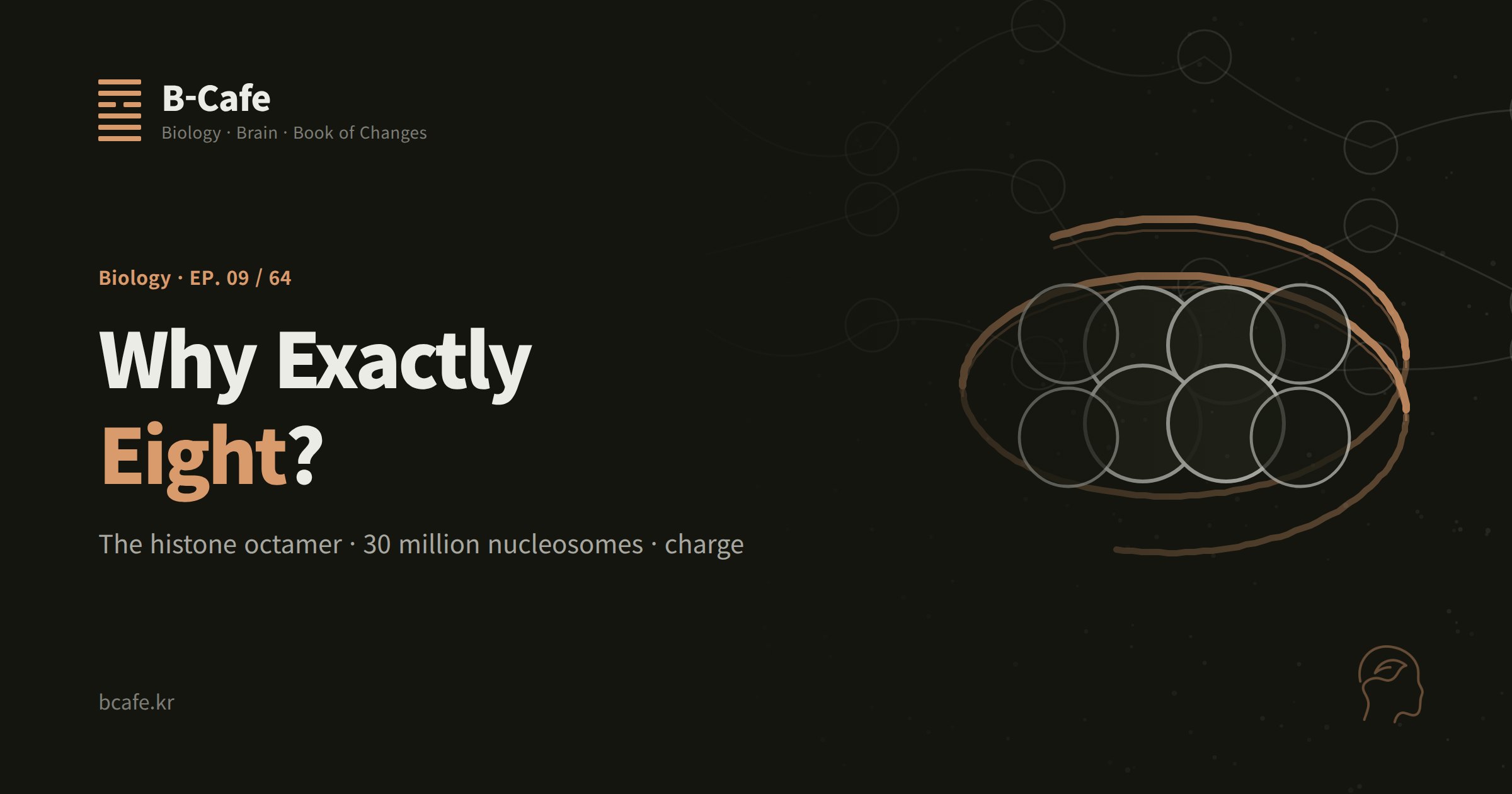
Why does the histone octamer have eight subunits?
The histone octamer is four kinds of protein in two copies each.
| Type | Count |
|---|---|
| H2A | 2 |
| H2B | 2 |
| H3 | 2 |
| H4 | 2 |
| Total | 8 |
But the eight do not arrive together. There is an order.
Two H3-H4 dimers combine into a tetramer that takes the central stretch of DNA first. Then two H2A-H2B dimers attach on either side.
The centre stands first and the outside comes after. Disassembly runs the same way: H2A-H2B leaves first. That order is where the room for regulation comes from.
The grip is charge, not a knot
Histones are unusually rich in lysine and arginine — over 20 percent of their amino acids. Both carry a positive charge at physiological pH.
DNA is negative because of the phosphates in its backbone.
histone + · DNA −
That is why it wraps. Nothing is tied and nothing is clipped. Opposite charges pull.
Which matters for one reason. If charge is what holds it, erasing the charge releases it.
215 kilometres in a thirty-metre room
Keep the conversion: a cell 10 μm across is a dome 50 metres wide. Five million times.
| What | Real | × 5,000,000 |
|---|---|---|
| Cell | 10 μm | 50 m dome |
| Nucleus | about 6 μm | 30 m room |
| Bare DNA | 2 nm thick | 1 cm thick |
| Histone octamer | 11 nm across | 5.5 cm · a fist |
| DNA on one octamer | 147 bp ≈ 50 nm | 25 cm |
| One chromosome | average 4.3 cm | 215 km |
| All 46 | about 2 m | 10,000 km |
Centimetre-thick thread, 215 kilometres of it, times forty-six strands — inside a room thirty metres across.
The draft put the nucleus at 20 metres; this keeps it at 30 to match the earlier instalment. A human somatic nucleus is usually 5–6 micrometres.
A turn and a half around a fist
A one-centimetre thread wraps 1.65 turns around a 5.5-centimetre ball. Twenty-five centimetres of it.
That unit is the nucleosome.
Count them:
6.4 billion base pairs ÷ a repeat of about 200 = roughly 30 million
Thirty million fists in one cell.
They are not spread evenly. Around the promoters where genes begin, there are stretches with no nucleosome at all — nucleosome-depleted regions.
An empty place is an open door. What gets left bare decides what gets read.
Not a bodyguard — a gatekeeper
One framing needs correcting here.
The picture of histones protecting DNA is only half right. Physical protection is closer to a side effect.
What histones actually do is block access. In eukaryotes a gene’s default state is closed, and histones are what close it. Opening requires deliberate work.
A bodyguard protects the VIP. A gatekeeper decides who gets in.
Histones are the second. Which is why they sit at the centre of gene regulation.
How is DNA unwound when a gene is needed?
Opening what is closed runs along two paths.
① Acetylation — neutralise the charge
Tails protrude from the histone core. Attach an acetyl group to a lysine on one of those tails and its positive charge disappears. The attraction weakens and the DNA loosens.
HATs add the group; HDACs remove it. Remove it and the grip tightens again.
② Remodellers — push it physically
Complexes such as SWI/SNF, ISWI, CHD and INO80 spend ATP to slide nucleosomes along, evict them, or swap histones out.
The first weakens the force; the second overpowers it. Both are used.
Held by charge, released by erasing charge. That structure is the point of this piece.
A cow and a pea
One number shows how untouchable a component a histone is.
A 1969 study compared histone H4 from a cow with histone H4 from a pea.
Of 102 amino acids, two differed.
Animals and plants diverged more than a billion years ago.
The reason is simple. A histone touches the whole genome. Change one position and the winding of every gene changes. There is almost no room to vary.
So what could not be varied got tails. The core is fixed; only the tails are modified.
Too early to call it a code
In 2000 the histone code hypothesis was proposed: that tail modifications — acetylation, methylation, phosphorylation — form combinations that carry information like a language.
It is an attractive idea and it has been cited enormously.
Whether it is really a code is not settled. It is often hard to tell whether a modification is cause or consequence, and the same mark can act in opposite directions depending on context.
A writing system read in order, or a set of marks reflecting a state? The question is open.
Neither a prison nor a lock
A nucleosome does not imprison. It does not seal.
Too loose and the information scatters; too tight and the information dies.
It holds without fixing, and lets go when needed.
That alternation — opening and holding — is what being alive consists of.
But why handle it this carefully?
Thirty million eight-part clusters hold it, and a protein that has changed two letters in a billion years guards it. What is that substance?
Why is it so long, why does it pair endlessly, and why did it end up so hard to alter?
DNA as matter that had to survive an age, rather than as a blueprint. That is the next instalment.
In short
- The histone octamer is two each of H2A, H2B, H3 and H4
- Assembly is ordered: an H3-H4 tetramer first, then H2A-H2B on either side
- The grip is electrostatic — histones over 20% lysine and arginine, DNA negative from its phosphates
- At 5 million times: the octamer is a 5.5 cm fist, DNA a 1 cm thread, one chromosome 215 km
- About 30 million nucleosomes per cell, with promoters deliberately left bare
- Histones are less a protective device than an access barrier. A gene’s default state is closed
- Two ways to open: acetylate lysines to neutralise charge, or spend ATP to push nucleosomes aside
- Histone H4 differs between cow and pea at 2 of 102 residues
- The histone code hypothesis was proposed but whether it is a code is unresolved
This piece is rebuilt for search readers from “Octamer” of the serial essay The Great Corona Swindle. The original’s point of view is kept; the numbers and mechanisms have been reset against primary sources.
Frequently asked
- Why does the histone octamer have eight subunits?
- Because four kinds of histone are present in two copies each: H2A, H2B, H3 and H4. Assembly is ordered. Two H3-H4 dimers combine into a tetramer that takes the central stretch of DNA first, and then two H2A-H2B dimers attach on either side to complete the eight.
- Why does DNA wrap around histones?
- Charge. Lysine and arginine make up more than 20 percent of a histone's amino acids and carry a positive charge at physiological pH. DNA is negative because of the phosphates in its backbone. Opposite charges attract. Nothing is tied or clipped.
- So how is it unwound when needed?
- Two mechanisms work together. One adds an acetyl group to lysines on the histone tails, neutralising the positive charge so the attraction weakens. The other uses chromatin remodelling complexes such as SWI/SNF, which spend ATP to physically slide or evict nucleosomes.
- How many nucleosomes are in one cell?
- About 30 million. A human cell has 6.4 billion base pairs and the nucleosome repeat is roughly 200 base pairs. They are not spread evenly, though — regions around gene promoters are deliberately left free of nucleosomes.
References
- Luger, K., Mäder, A. W., Richmond, R. K., Sargent, D. F., Richmond, T. J. (1997). Crystal structure of the nucleosome core particle at 2.8 Å resolution. Nature, 389, 251–260. — Octamer structure, 147 base pairs at 1.65 turns, and the position of the histone tails.
- DeLange, R. J., Fambrough, D. M., Smith, E. L., Bonner, J. (1969). Calf and pea histone IV. Journal of Biological Chemistry, 244(2), 319–334. — Cow and pea histone H4 differ at only 2 of 102 residues.
- Andrews, A. J. & Luger, K. (2011). Nucleosome structure(s) and stability: variations on a theme. Annual Review of Biophysics, 40, 99–117. — The assembly path: H3-H4 tetramer first, H2A-H2B dimers after.
- Clapier, C. R. & Cairns, B. R. (2009). The biology of chromatin remodeling complexes. Annual Review of Biochemistry, 78, 273–304. — How SWI/SNF, ISWI, CHD and INO80 move nucleosomes using ATP.
- Strahl, B. D. & Allis, C. D. (2000). The language of covalent histone modifications. Nature, 403, 41–45. — The histone code hypothesis — proposed, and still disputed.
- Jiang, C. & Pugh, B. F. (2009). Nucleosome positioning and gene regulation: advances through genomics. Nature Reviews Genetics, 10, 161–172. — Nucleosome-depleted regions at promoters and their role in regulation.
Published September 29, 2026