Why Three Letters at a Time — The 64-Codon Table, Frameshift, and a Frozen Accident
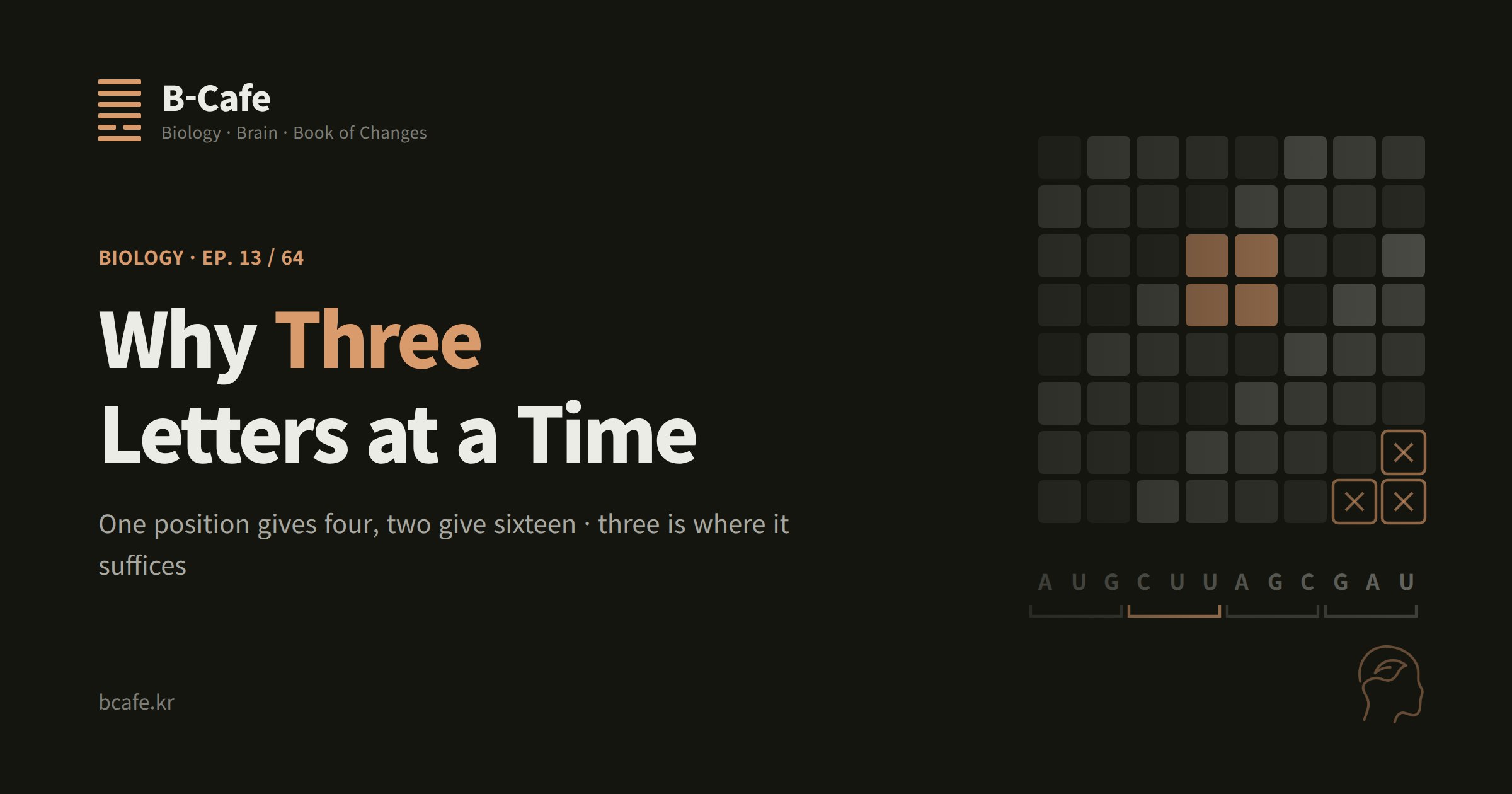
One position gives four, two give sixteen. Not enough to name twenty. Three is where it becomes enough. Three is not ornament. It is the number required.
English runs on twenty-six letters. Korean uses forty — nineteen consonants and twenty-one vowels.
Life uses four.
A, T, G, C.
Not an agreement — a fit
The previous piece described four bases hanging from the sugar-phosphate backbone.
A faces T, G faces C. Not because a rule says so. Because that is what fits.
| Base | Rings | Size |
|---|---|---|
| A, G | purine | two rings |
| C, T | pyrimidine | one ring |
Every pair is one purine and one pyrimidine. Three rings across, always. Which is why the helix holds the same diameter everywhere.
Two purines would bulge. Two pyrimidines would sag. Neither makes a thread.
A-T has two hydrogen bonds, G-C three. The one with more holds a little tighter — stretches richer in G and C melt at higher temperatures.
The two strands mirror each other. When one is disturbed the other is the reference. One is the record and the other the witness.
Why three
A counting problem.
| Positions | Possible arrangements | Enough for 20? |
|---|---|---|
| 1 | 4 | ✕ |
| 2 | 16 | ✕ — four short |
| 3 | 64 | ○ |
Two will not do. Sixteen is less than twenty. Four short, and the whole system fails to close.
Three positions give 64, and only then is it enough.
The person who first set out the argument was not a biologist. In 1954 it was the physicist George Gamow. The model he proposed was wrong. The conclusion that it had to be three stood.
Three is not ornament. It is the number required.
How the three was proved
The proof came seven years later. 1961: Crick, Barnett, Brenner and Watts-Tobin.
They inserted and deleted bases in the rII gene of phage T4.
| Bases inserted | Result |
|---|---|
| 1 | function broken |
| 2 | broken |
| 3 | function returns |
Insert one and everything downstream shifts a notch. Insert two and it shifts two. Insert three and it shifts three — back into its original register.
Direct evidence that the reading unit is three. Found without reading a single base of sequence, only by putting bases in and taking them out.
Sixty-four arrangements, fewer than sixty-four meanings
Here is the strange part.
GAA and GAG are spelled differently and specify the same thing. Glutamate.
GGU, GGC, GGA and GGG are all glycine.
Of the 64, 61 specify amino acids and 3 are stop. Sixty-one split across twenty, so on average each is named three ways.
The overlap is not random.
| Position | What it does |
|---|---|
| First | makes the broad division |
| Second | largely determines hydrophobicity |
| Third | relatively free |
Every codon with U in the second position is a hydrophobic amino acid. Phenylalanine, leucine, isoleucine, methionine, valine. No exceptions.
So a mutation at the third position usually does nothing, and a mutation at the second changes the character outright.
The table is not perfect. It is hard to knock over.
The frame is another matter
A gap is survivable. A frame is not.
Shift the three-letter rhythm by one and every word after it becomes a different word. Frameshift.
A substitution and an insertion are not the same order of event.
| What changes | |
|---|---|
| One base swapped for another | one amino acid, or nothing |
| One base inserted or deleted | everything after it |
And a substitution is not small either. The D614G change reported in the SARS-CoV-2 spike protein in 2020 was a single amino acid, and it made a measurable difference to transmission.
One letter swapped changes a surface, and a changed surface changes what recognises it.
The reading machine inside the 50-metre dome
Set the scale again. One cell as a dome 50 metres across, the nucleus 30 metres.
The machine that reads three letters at a time is the ribosome.
The eukaryotic 80S ribosome is 25–30 nanometres across. At this scale, 12.5 to 15 centimetres. A ball a little larger than a softball.
That ball runs along a thread a centimetre thick, cutting it three notches at a time.
Nearly universal, not quite
The table is nearly the same in bacteria, in plants, in people. Billions of years on the same grammar.
But nearly is doing work.
In 1979 Barrell’s group read the genetic code of human mitochondria.
| Codon | Standard table | Human mitochondria |
|---|---|---|
| UGA | stop | tryptophan |
| AGA, AGG | arginine | stop |
Two tables run inside one cell. The nucleus uses its own; the mitochondrion uses another.
There are more exceptions. Given a specific structural element, UGA codes selenocysteine instead of stop, and in some archaea UAG codes pyrrolysine.
There are not twenty amino acids. Under the right conditions there are twenty-two.
A frozen accident
Why was the table never changed?
Because it cannot be.
Correct one cell of the table and every protein written through that cell changes simultaneously. One improvement traded for tens of thousands of failures.
In 1968 Crick called this a frozen accident. The assignment may have been arbitrary at the start, but once it was in use the cost of changing it went to infinity and it froze where it stood.
There is a competing account. The 1998 calculation by Freeland and Hurst, met in the previous piece — the standard table sits roughly one in a million on a scale of how little mutation disturbs. Selected, not accidental.
Which account dominates is unsettled. Probably both do.
This article’s definition
Fixed here.
The codon table is not the best available design. It is an agreement that became irreversible.
Life did not invent a new language. It only played variations on the one it had — not because the old one could not be improved, but because it could not be replaced.
Four letters, 64 arrangements, 20 materials. Every living thing on Earth stands on this one small table.
Not an alphabet. The grammar of this world.
Waiting for the copier to slip
Immunity remembers shape. It recognises the contours of a protein’s surface.
The intruder does not break the structure. It alters the sequence. Twist three letters and recognition changes.
A code is invisible. The moment it is read it becomes matter.
And the machine that copies that translation most accurately still has an error rate. An RNA virus misreads roughly one base in ten thousand to one in a million per round of replication — hundreds of thousands of times the rate of DNA replication.
The intruder does not design. It waits for the copier to slip.
In short
- Every pair is one purine and one pyrimidine, three rings across, so the helix keeps one diameter
- One position gives 4, two give 16, short of 20. Three give 64 and that is enough
- The combinatorial argument is Gamow 1954; the proof is Crick’s 1961 insertion-deletion experiment
- Of 64 codons, 61 specify amino acids and 3 specify stop
- The second position largely determines hydrophobicity; the third is relatively free
- A substitution changes one amino acid; an insertion or deletion changes everything after it
- The ribosome is 25–30 nanometres across — 12.5 to 15 centimetres at this scale
- Human mitochondria read UGA as tryptophan. One cell runs two tables
- Given the right conditions, selenocysteine and pyrrolysine take the count to 22
- Change the table and every protein built to it breaks together. Crick called it a frozen accident
This piece is rebuilt for search readers from “The Code Table” of the serial essay The Great Corona Swindle. The original’s point of view is kept; the mechanisms and numbers have been reset against primary sources.
Frequently asked
- Why three letters?
- It is a combinatorial constraint. With four bases, one position offers 4 possibilities and two positions 16 — fewer than the 20 amino acids that need naming. Three positions give 64, which suffices. George Gamow published the argument in 1954; the specific model he proposed was wrong, but the conclusion that it had to be three survived.
- How was the three-letter unit proved?
- In 1961 Crick, Barnett, Brenner and Watts-Tobin inserted and deleted bases in the rII gene of phage T4. One insertion broke function, two broke it, and three restored it. The reading unit is three, so only three insertions shift the downstream frame back into register. It is the decisive evidence that the genetic code is a triplet code.
- Is the table the same in every organism?
- Nearly, and not quite. In 1979 Barrell's group established that in human mitochondria UGA codes tryptophan rather than stop, and AGA and AGG serve as stop. Some ciliates read UAA and UAG as glutamine. And under particular conditions UGA specifies selenocysteine and UAG specifies pyrrolysine, taking the amino acid count from 20 to 22.
- Why has the table never changed?
- Alter one cell of the table and every protein written with that cell changes at once — one improvement traded against tens of thousands of failures. Crick called this a frozen accident in 1968. Set against it is the calculation that the current table is selected for limiting the damage of mutation, so which account dominates is still unsettled.
References
- Gamow, G. (1954). Possible relation between deoxyribonucleic acid and protein structures. Nature, 173, 318. — The combinatorial argument that four letters must group in threes. The specific model was wrong.
- Crick, F. H. C., Barnett, L., Brenner, S., Watts-Tobin, R. J. (1961). General nature of the genetic code for proteins. Nature, 192, 1227–1232. — One and two insertions break function; three restores it.
- Nirenberg, M. W. & Matthaei, J. H. (1961). The dependence of cell-free protein synthesis in E. coli upon naturally occurring or synthetic polyribonucleotides. PNAS, 47(10), 1588–1602. — The first codon read: UUU specifies phenylalanine.
- Crick, F. H. C. (1968). The origin of the genetic code. Journal of Molecular Biology, 38(3), 367–379. — The frozen accident hypothesis.
- Freeland, S. J. & Hurst, L. D. (1998). The genetic code is one in a million. Journal of Molecular Evolution, 47(3), 238–248. — The table is biased towards limiting mutational damage — the competing account.
- Barrell, B. G., Bankier, A. T., Drouin, J. (1979). A different genetic code in human mitochondria. Nature, 282, 189–194. — UGA as tryptophan, AGA and AGG as stop, in human mitochondria.
- Böck, A. et al. (1991). Selenocysteine: the 21st amino acid. Molecular Microbiology, 5(3), 515–520. — UGA recoded to selenocysteine in the presence of a specific element.
- Srinivasan, G., James, C. M., Krzycki, J. A. (2002). Pyrrolysine encoded by UAG in Archaea. Science, 296(5572), 1459–1462. — The 22nd amino acid, specified by UAG in archaea.
- Ben-Shem, A. et al. (2011). The structure of the eukaryotic ribosome at 3.0 Å resolution. Science, 334(6062), 1524–1529. — The structure and dimensions of the eukaryotic ribosome.
- Korber, B. et al. (2020). Tracking changes in SARS-CoV-2 spike: evidence that D614G increases infectivity of the COVID-19 virus. Cell, 182(4), 812–827. — What one changed amino acid did to transmission.
- Smith, L. M. & Kelleher, N. L. (2013). Proteoform: a single term describing protein complexity. Nature Methods, 10(3), 186–187. — The gap between gene count and the number of distinct protein forms.
Published October 3, 2026