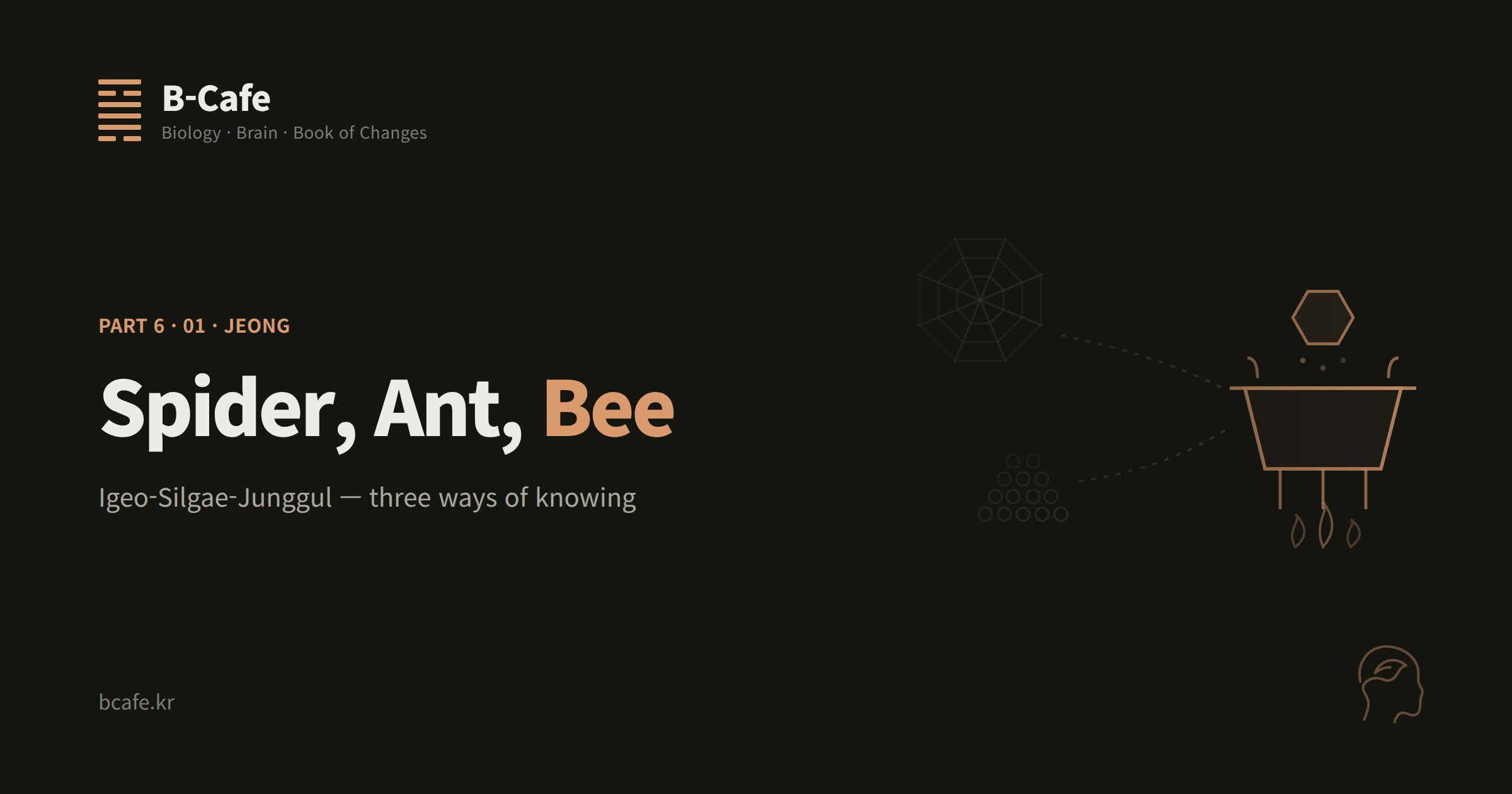
Igeo-Silgae-Junggul — The Theorist Is a Spider, the Experimenter an Ant, the Middle Way a Bee
Six syllables a first-year high school student made up in 1989 to get through a test. Thirty-seven years later they came back as the structure of a life. Honey is not halfway between flower and bee. It is a third substance left behind after enzymes split the sucrose and the water is driven off.
Summer, 1989. A social studies class, first year of high school.
The theorist is like the spider, the experimenter like the ant, the one of the middle way like the bee.
Francis Bacon’s figure, turned into a private episodic memory, written down in a notebook.
Igeo-Silgae-Junggul.
Six Korean syllables. Each pair takes the first syllable of a word and the first syllable of its animal.
I-geo — the theorist (이론가), the spider (거미). Sil-gae — the experimenter (실험가), the ant (개미). Jung-gul — the one of the middle way (중도자), the bee (꿀벌).
Translate the six syllables and the thing dies. So they stay as they are.
That vacation, he went back to the seodang in his home village, the village Confucian school.
The old master stroked his beard and asked.
“You there. Are you studying hard, up in Seoul?”
“Yes, sir. I am studying hard.”
“And what new principle have you grasped?”
”……”
“The Master said: 學而時習之 不亦說乎. To learn, and in due time to practise it — is that not a delight?”
“Igeo, Silgae, Junggul.”
”……!”
“That… that passage… in which of the classics does it appear?”
A rubbish mnemonic a high schooler built to pass a test, and the mouth of the old master who was said to have read through the Four Books and Three Classics shut on the spot.
Thirty-seven years later, he comes to know it at last.
Inside those six syllables the track he had walked and the road still ahead were lying together.
The source, nailed down first
This figure was not invented.
Francis Bacon, Novum Organum (1620), Book I, Aphorism XCV (95).
| Bacon’s own arrangement | |
|---|---|
| Spider | the dogmatical — spins the web out of its own substance |
| Ant | the empirics — only collects and uses |
| Bee | a middle course — gathers, but transforms by its own power |
To here it overlaps exactly with the author’s six syllables.
But two things do not line up.
First, inside Aphorism XCV the names of Plato and Aristotle do not appear. The two of them turn up in the very next one, XCVI (96).
The second matters more.
Bacon himself filed Aristotle with the spider, not with the ant.
In Aphorism LXIII (63) he writes that Aristotle settled the question by his own will before the experiments had been examined, then resorted to experience and led her about like a captive in a procession, bent to the conclusion. In LXVII (67) he writes that Aristotle’s philosophy, having destroyed the rival systems, laid down the law on all points.
The book Novum Organum is itself a title that announces it will replace Aristotle’s Organon.
So putting Aristotle in the ant’s place is not Bacon’s arrangement.
It is the author’s rearrangement.
And that rearrangement stands on its own terms. The observation and classification of Historia Animalium really was a gathering of experience. Only — the fact that it is not Bacon’s has to be written down. Writing it down does not weaken the figure. It makes plain who said what.
The world moves in three ways
The theorist is like the spider.
Draws thread out of himself and builds an exact web.
Like Plato, who tried to explain the nature of the world by an Idea beyond the senses, he puts the concept ahead of what is there.
The logic is brilliant, the structure without a gap.
But thinking never tested against the real, however fine, never gets outside its own conviction.
The experimenter is like the ant.
Goes outside and gathers material without stopping.
Like Aristotle, who left his teacher Plato’s Idea to observe and classify plants and animals, he weighs what is in front of his eyes.
Yet experience in any quantity, if it is not strung on a single principle, is no more than feed piled in a store.
The data overflows and the whole board stays invisible.
Then who is the one of the middle way.
Not a man standing between spider and ant, conceding half to each.
Not one who stirs theory and experience together and badly.
Honey is not nectar boiled down
The bee brings nectar in from outside but does not stack it up as it came.
Inside its own body it digests and transforms it.
This is not rhetoric. It is chemistry.
| What went in (nectar) | What came out (honey) | |
|---|---|---|
| Water | 70–80% | about 18% |
| Chief sugar | sucrose | glucose + fructose |
| Acidity | near neutral | acidic (gluconic acid) |
| Microbes | grow | cannot grow |
The bee mixes in invertase from the hypopharyngeal gland and cuts the bond of the sucrose. One molecule splits into two.
At the same time, fanning and passing it mouth to mouth over and over, it drives the water off.
Then glucose oxidase turns part of the glucose into gluconic acid and hydrogen peroxide. The acidity drops, hydrogen peroxide appears, and honey becomes a place where microbes cannot live.
Between what went in and what came out, sugar composition, water, acidity and enzyme profile are all different.
Honey is not halfway between flower and bee.
It is the third result that their meeting made.
The middle way is not compromise.
It is taking in two unlike forces and bringing to birth what was in neither of them.
Like Steve Jobs, who brought the calligraphy class he audited after dropping out of college back to life in the Macintosh ten years later, and at the intersection of technology and the liberal arts set out a new way of living with the iPhone.
Blocked, it changes
Looking back, spider and ant were tangled together along every road he had walked.
Blocked, it changes; changed, it passes through; passing through, it lasts.
窮則變, 變則通, 通則久.
The Book of Changes, “Xici” (Great Treatise) II, chapter 2.
易 窮則變 變則通 通則久
Look at the order once more. Change does not come first. Blockage comes first.
It must be blocked to change, changed to pass through, passing through to last. What is not blocked has no reason to change.
In Part 1 “Change (易)” he read the principle of changing through 易.
In Part 2 “The Game” and Part 4 “The Money Game” he threw himself into the life game and the money game and paid the price of his choices.
In Part 3 “Outside the Cell” he looked into viruses and life and tracked what outlasts any single body.
Reaching Part 5 “Mind Only (一切唯心造)” he came to see that the same world becomes an entirely different life according to the mind that looks at it.
At some times he was caught in the web he had made himself,
in other seasons he chased the feed in front of him and wandered the dirt.
But the spider’s thinking and the ant’s experience were not failures to be thrown out.
They were the material before the honey.
Same wind, different man
On the road running down to Busan, the cold night wind struck his cheek.
In the first life that wind would have been fatigue.
In the second life it was the sense of being alive.
The wind was unchanged. Only the man taking it in had become someone else.
The moment the same experience turns into an entirely different meaning.
Part 6, now beginning, dissects these three ways of living one after another.
Shut inside the concept like the spider,
farmed by the data like the ant,
or, like the bee, leaving behind out of what was gathered something that was not there before.
The hexagram of this piece
鼎. Wind (巽) below, fire (離) above.
Fire above wood. The cauldron.
木上有火 鼎 君子以正位凝命
Fire above wood. The noble one sets his place right and makes his charge firm.
The Sequence of the Hexagrams writes why it puts this hexagram here.
革物者莫若鼎 故受之以鼎
For transforming things there is nothing like the cauldron. Therefore 鼎 receives it.
The cauldron is not a vessel that mixes.
It is a vessel you put the raw into and pull out what was never inside it.
Pile the spider’s thread and the ant’s feed in the same place and you have a pile. Put them in the cauldron and they become something else.
The body of the bee is that cauldron.
The definition this piece fixes
Fixed here.
The middle way (中道) is not compromise but transformation.
Not the midpoint of two forces, but passing two forces through and putting out a third thing that was in neither.
As honey is not a concentration of nectar but a different substance left after enzymes cut the bonds and the water is driven off.
So the spider’s thinking and the ant’s experience are not failure but material. They become failure only when there is no cauldron.
Monologue of 1031 intruders
We are neither spider nor ant.
We have no body to draw thread from, and no store to keep anything in.
We have only the cauldron. Someone else’s cauldron.
We go inside your bodies and make ourselves out of your material. What we are going in and what we are coming out are not the same.
You call it mutation.
We call it honey.
In brief
- The source of the spider-ant-bee figure is Bacon, Novum Organum (1620), Book I, Aphorism XCV (95)
- Bacon’s arrangement is spider = the dogmatical, ant = the empirics, bee = a middle course
- Inside Aphorism XCV the names of Plato and Aristotle do not appear. The two turn up in XCVI (96)
- Bacon himself filed Aristotle with the spider (Aphorisms LXIII, 63 and LXVII, 67). Putting him in the ant’s place is the author’s rearrangement
- Honey is not concentrated nectar. Invertase splits sucrose into glucose and fructose
- Water falls from 70–80% to about 18%, and glucose oxidase makes gluconic acid and hydrogen peroxide
- Sugar composition, water, acidity and enzymes all change. Not concentration but transformation
- 窮則變 變則通 通則久 is the “Xici” (Great Treatise) II, chapter 2. The order makes blockage the condition of change
- The Sequence of the Hexagrams for 鼎 writes 革物者莫若鼎 — for transforming things there is nothing like the cauldron
Carrying the spider’s thinking and the ant’s experience, he turns toward the middle way (中道).
Igeo-Silgae-Junggul.
Six syllables memorised thirty-seven years ago have come back at last as the alchemy of a life.
This is the first piece in the “Igeo-Silgae-Junggul,” chapter of the serial essay The Great Corona Swindle. The 1989 seodang exchange and the night wind on the road to Busan are the author’s own; Bacon’s text, the biochemistry of honey and the classical text have been reset against primary sources. No company or individual is referred to.
Frequently asked
- Whose figure is the spider, the ant and the bee?
- Francis Bacon's. It appears in <em>Novum Organum</em> (1620), Book I, Aphorism XCV (95). Having set out that those who have handled the sciences were either the empirics or the dogmatical, Bacon writes that the empirics, like the ant, only collect and use, while the dogmatical, like the spider, spin webs out of their own substance. The bee takes a middle course, gathering its material from the flowers of the garden and the field but transforming it by its own power. Bacon took this for the labour of true philosophy.
- Did Bacon call the spider Plato and the ant Aristotle?
- No. Neither name appears inside Aphorism XCV. Plato and Aristotle turn up in the very next one, Aphorism XCVI (96). More to the point, Bacon's own filing runs the other way. In Aphorism LXIII (63) he charges Aristotle with settling the question first and then dragging experience about like a captive to fit the conclusion, before the experiments had been examined. In Aphorism LXVII (67) he writes that Aristotle's philosophy, after destroying the rival systems, laid down the law on all points. For Bacon, Aristotle is on the spider's side, not the ant's. Putting Aristotle in the ant's place is not Bacon's arrangement but the author's rearrangement, and it stands on its own terms. The observation and classification of <em>Historia Animalium</em> really was a gathering of experience.
- Is honey concentrated nectar?
- No. Nectar is 70–80% water and most of its sugar is sucrose. The bee mixes in invertase from the hypopharyngeal gland and splits the sucrose into glucose and fructose. At the same time, through repeated fanning and storing, the water is driven down to around 18%. Glucose oxidase then converts part of the glucose into gluconic acid and hydrogen peroxide. The acidity drops and hydrogen peroxide appears, and microbes can no longer live there. Sugar composition, water content, acidity and enzyme profile all differ between what went in and what came out. Not concentration. Transformation.
- Where does 窮則變 變則通 通則久 come from?
- The Book of Changes, "Xici" (Great Treatise) II, chapter 2. It reads 易 窮則變 變則通 通則久 — the Changes: blocked, it changes; changed, it passes through; passing through, it lasts. Three clauses that compress how the Changes operate, and the order records that the condition of change is not change itself but blockage.
- What kind of hexagram is 鼎?
- The cauldron. The image reads 木上有火 鼎 君子以正位凝命 — fire above wood, the cauldron; the noble one sets his place right and makes his charge firm. The Sequence of the Hexagrams places 鼎 after 革 and writes 革物者莫若鼎 故受之以鼎 — for transforming things there is nothing like the cauldron, therefore 鼎 receives it. Not a vessel that mixes, but one that makes what was never in the ingredients.
References
- Bacon, F. (1620). Novum Organum, Book I, Aphorism XCV. — The ant is the empirics, the spider the dogmatical, the bee the middle course. No name of Plato or Aristotle inside this aphorism.
- Bacon, F. (1620). Novum Organum, Book I, Aphorisms LXIII and LXVII. — The passages in which Bacon attacks Aristotle as one of the dogmatical. The spider's side, not the ant's.
- Machado De-Melo, A. A., Almeida-Muradian, L. B., Sancho, M. T., Pascual-Maté, A. (2018). Composition and properties of Apis mellifera honey: A review. Journal of Apicultural Research, 57(1), 5–37. — The splitting of sucrose by invertase, water content, and the production of gluconic acid and hydrogen peroxide by glucose oxidase.
- Jobs, S. (2005). Commencement Address, Stanford University, June 12, 2005. — Where Jobs himself joined the calligraphy class he audited after dropping out of Reed College to the design of the Macintosh.
- Aristotle. Historia Animalium. — Observation and classification of animals. A work whose character as a gathering of experience is plain.
- Book of Changes, "Xici" (Great Treatise) II, ch. 2 — 易 窮則變 變則通 通則久. — The order in which blockage is the condition of change. Change does not come first.
- Book of Changes, hexagram 50 (鼎): image and the Sequence of the Hexagrams. — The cauldron is not a vessel that mixes but a vessel that transforms.
Published October 17, 2026